


7 Effective Ways to Teach Communication Skills to Children
- Why are communication skills important for children?
- Stages of communication skill development in children
-
Methods for teaching communication skills to children
- 3.1 Take time to talk with your children
- 3.2 Creating a healthy communication environment for children
- 3.3 Encourage children to read books and tell stories
- 3.4 Encourage children to express their personal opinions
- 3.5 Create opportunities for children to participate in teamwork
- 3.6 Let your child participate in outdoor activities
- 3.7 Teaching communication skills to children through games
- Developing comprehensive communication skills for children at VAS
Teaching communication skills helps children build confidence, express themselves clearly, and interact effectively with others. For children to be able to express their opinions and emotions clearly and effectively, parents need to help and guide them from their early years. Especially in a modern, challenging, and competitive environment, communication skills are becoming more important than ever. So, how can we teach children this skill effectively? Let's find out more with VAS through 7 effective methods in the following article.
1. Why are communication skills important for children?
1.1. Language development and expressive abilities
Language plays an important role in every person's life, so teaching communication skills to children from an early age will greatly help their future development, such as: knowing how to grasp information and developing expressive abilities, using words fluently and skillfully. In particular, children who communicate well tend to be more socially confident and well-liked and easily succeed in the future.
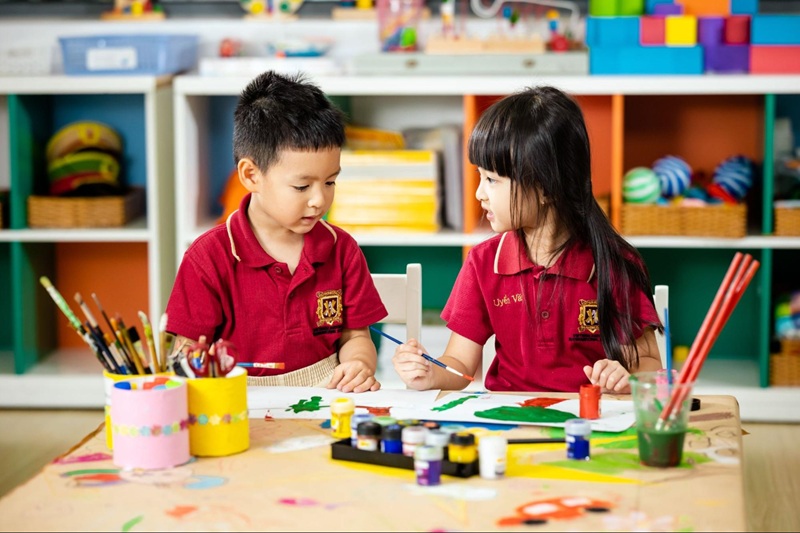
Teaching communication skills to children through games
1.2. Building social relationships
Children with good communication skills usually have more friends, which helps them quickly integrate into new environments, strengthen the building of surrounding relationships, or make friends. When growing up, communication skills also help them have more relationships with friends, partners... thanks to which they are more likely to succeed later in life.
1.3. Enhancing confidence in communication
Strong communication skills often build confidence; therefore, training children in communication skills in daily life or speaking in public will help them gradually break down language barriers and previous low self-esteem.
2. Stages of communication skill development in children
- Pre-verbal stage: newborns are easily stimulated by sounds from the surrounding environment such as: voices of relatives, animal sounds, object sounds, and other noises. During this stage, children respond through physical reactions and express desires by crying.
- Conscious communication stage: children understand more about language and use gestures to communicate or imitate adults.
- Single-word stage: children understand keywords in familiar contexts, and start speaking more single words to express personal needs.
- Early sentence stage: children can use paired words and communicate in short sentences with a diverse vocabulary in different situations.
3. Methods for teaching communication skills to children
3.1. Take time to talk with your children
Parents should take the time to talk regularly with their children. This is a simple but very effective way of teaching communication skills to children because talking regularly helps build a stronger connection. Especially, children will be more talkative and develop their thinking skills if parents take the time to care for and answer their innocent questions.
Answering a child's questions seems simple, but it is how parents are helping them form associative thinking and a rich imagination because they are provided with a lot of information from adults.
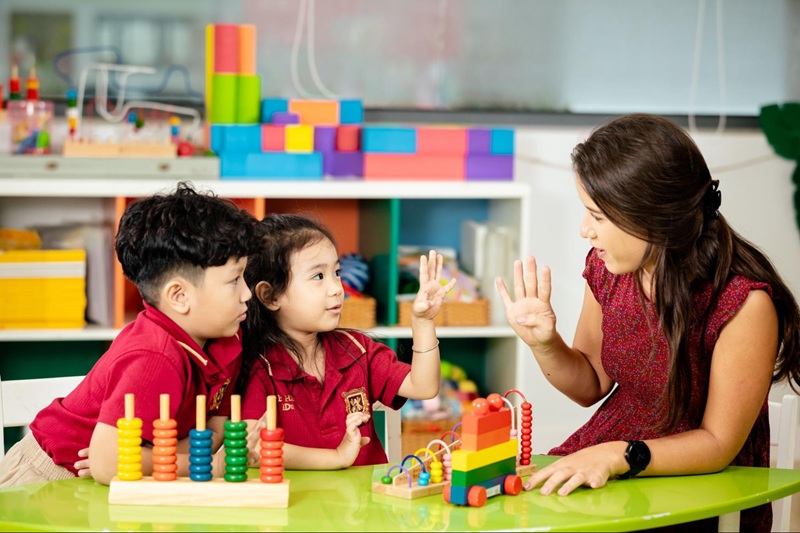
Parents should spend a lot of time talking with children to develop communication skills
3.2. Creating a healthy communication environment for children
To teach communication skills to children effectively, surrounding environmental conditions also play a very important role. In addition to being a standard role model in communication for children at home, parents should also take them to play in different places so they can observe and discover new things, see and hear, and expand their vocabulary better.
3.3. Encourage children to read books and tell stories
Encouraging children to tell stories to parents or read books with parents is also a method to practice communication skills and cultivate language for young children. If possible, put on a short play with your child to increase their excitement.
Developing a reading habit helps children prepare for listening - speaking - reading - writing skills in Vietnamese when entering 1st grade.
3.4. Encourage children to express their personal opinions
One of the effective ways of teaching communication skills to preschool children is to stimulate their ability to speak and express their emotions and opinions. In fact, every child has a different personality. Some children are very lively and active, ready to share all their thoughts and desires, but some are shy, introverted, and not proactive in communication. In this situation, parents need to spend time talking with their children more to stimulate them to talk and express their emotions and opinions.
Parents should find topics that children love to ask questions or tell stories for them to hear. Then ask the child about the story they just heard to encourage more interaction. When feeling cared for, children will be ready to share andfeel more comfortable expressing themselves, thereby creating confidence when communicating.
3.5. Create opportunities for children to participate in teamwork
Group activities are a great way to develop communication skills to children because they need to socialize, get acquainted, and interact with others to learn about a certain issue. Through this, they are more open and confident to share and express their ideas and opinions. Furthermore, the teamwork process also helps them learn more skills in persuasion, negotiation, and problem-solving. Therefore, teamwork is a way to help children develop communication skills quickly.
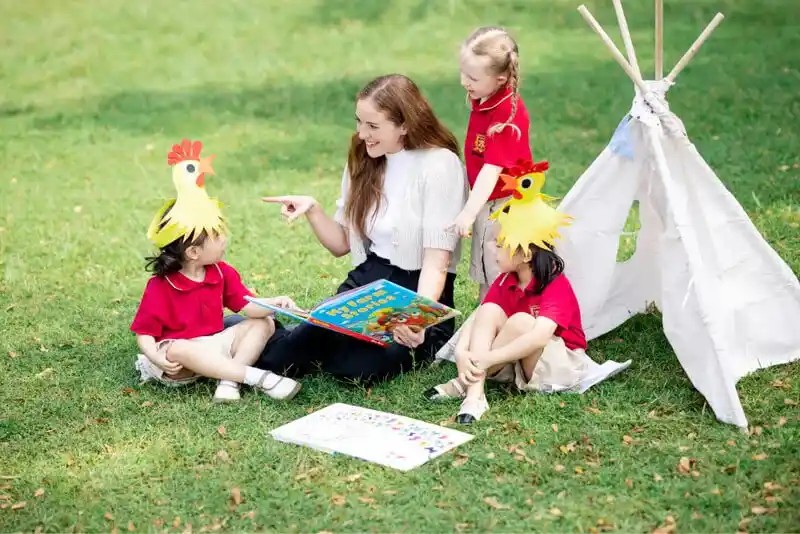
Create opportunities for children to participate in teamwork
3.6. Let your child participate in outdoor activities
Outdoor activities such as: playing sports, walking in the park, participating in outdoor group games... both help children with physical training and increase their ability to communicate with people around them. Besides, these activities are also an opportunity for children to explore the outside world and new, useful things.
3.7. Teaching communication skills to children through games
Games play an important role in creating an environment for children to develop healthy thinking, stimulating imagination and creativity. When exposed to smart games, children will become more confident and socially engaged with the surrounding world. Some games that stimulate children's intelligence include: picture puzzles, chess, Jenga...
4. Developing comprehensive communication skills for children at VAS
Vietnam Australia International School - VAS, with 20 years of teaching experience,helps build a strong academic foundation for young children, not only focusing on teaching communication skills to children but also comprehensive development in other aspects such as: aptitude, physicality, language, and skills.
- Language: Every week, children study English for 10 - 22 periods, developing natural reflex skills and the ability to develop bilingualism during the preschool stage. In addition, children also learn Math and Science in English to prepare for the Cambridge Primary level.
- Physicality: Many outdoor physical activities every morning, periodic health check-ups, and care for students to ensure each child has physical and physiological attributes developed naturally.
- ICT: Students get acquainted with basic computer software, learn how to use the keyboard... increasing understanding to get in touch with a new knowledge base.
- Life skills: From behavioral skills, communication, and independence to teamwork skills, public speaking... are developed through activities during class time.
- Aptitude: Many attractive competitions for children to show off their talents and confidence in public such as English Speaking Contest, VAS Olympic, VAS’s Got Talent...

VAS always creates conditions for children to confidently show their talents
>>> Read more: Detailed updates on the VAS international school tuition fee schedule
Besides these things, VAS also organizes after-school extracurricular activities in fields such as: cooking, yoga, basketball, soccer... to help children play, exercise, improve their understanding, and practice their inherent aptitudes.
With the above information, hopefully, parents will update more useful knowledge as well as gain more experience in teaching communication skills to children. In addition, parents who wish to learn about the curriculum at Vietnam Australia International Preschool - VAS can contact the hotline number 0911 26 77 55 or website: www.vas.edu.vn to get support from our consulting team!
>>> Read more: Why parents should choose VAS international school for their children?