


An Overview of Cambridge English Certificates for Primary Students
-
A Brief Overview of Cambridge Certificates for Primary School Students
- 1.1 What are Cambridge English certificates for primary school students?
- 1.2 Age range for taking Cambridge English certificates
- 1.3 Characteristics of the three Cambridge certificates: Starters, Movers, and Flyers
- 1.4 Cambridge certificate exam structure
- 1.5 How Cambridge exam scores are calculated
- 1.6 What should children prepare before taking the Cambridge YLE exam?
- Why should children take Cambridge certificate exams?
- VAS – Paving the Way for Young Generations to Access Quality Education
- Conclusion
With many advantages, Cambridge English certificates for primary students can give children more opportunities and help them feel more confident as they move on to higher levels of education. So, what are the benefits of having children take Cambridge certificate exams, and what is the exam format like?
Let’s explore the key information parents should know about Cambridge English certificates for primary students with VAS in the article below.
1. A Brief Overview of Cambridge Certificates for Primary School Students
1.1 What are Cambridge English certificates for primary school students?
Cambridge English certificates for primary students, also known as Young Learners English Tests (YLE), are a set of English proficiency tests designed for primary school-aged children. These exams help teachers and parents assess children’s English ability and build a suitable, personalised learning pathway for them.
First introduced in 1997 by Cambridge Assessment International Education (CAIE), Cambridge Young Learners exams quickly became a trusted assessment for evaluating the English proficiency of young learners around the world.
The YLE exams include 3 levels: Starters, Movers, and Flyers, corresponding to children’s English proficiency from basic to more advanced levels.
Each level includes 3 papers: Reading & Writing, Listening, and Speaking. Preparing for and taking these exams gives children the opportunity to improve their English skills, strengthen communication ability, and receive an internationally recognised certificate from Cambridge.
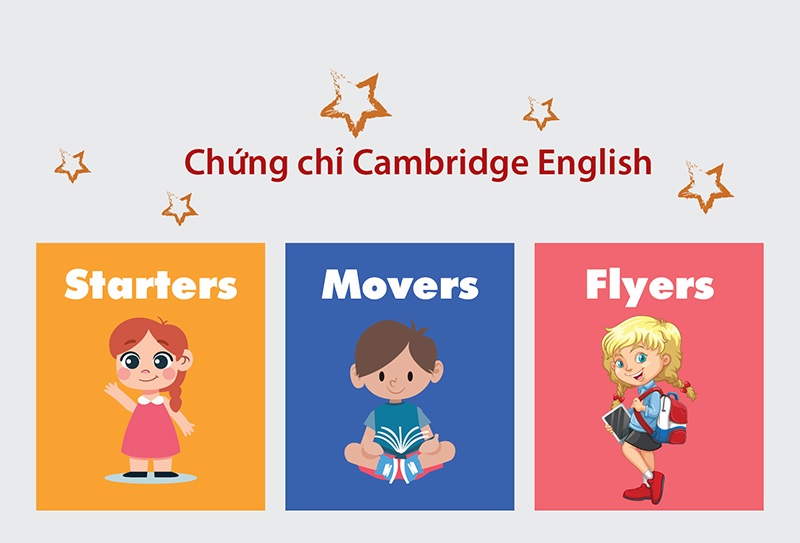
The three levels of Cambridge English certificates for primary students
1.2 Age range for taking Cambridge English certificates
The Cambridge English certificates at Starters, Movers, and Flyers levels are part of the Young Learners English (YLE) system. These certificates are recognised in more than 150 countries and are designed for children aged 7 to 12, with increasing levels of difficulty.
- Starters: For children from 7 years old who have completed about 100 hours of English study.
- Movers: For children aged 7–11 who have completed about 175 hours of English study.
- Flyers: For children aged 9–12 who have completed about 250 hours of English study.
1.3 Characteristics of the three Cambridge certificates: Starters, Movers, and Flyers
The Starters, Movers, and Flyers exams are carefully designed to be engaging, interactive, practical, and suitable for young learners. The tests focus on helping children use English in context and respond to real-life situations. This allows teachers and parents to assess children’s actual ability across Listening, Speaking, Reading, and Writing.
These exams not only encourage children’s interest in English but also give them more motivation to continue learning. A special feature of Cambridge Young Learners exams is that there is no pass or fail result. Every young candidate who completes the exam receives a certificate of results. This helps build confidence, encourages a positive attitude toward exams, reduces pressure, and motivates children to keep improving in future tests.
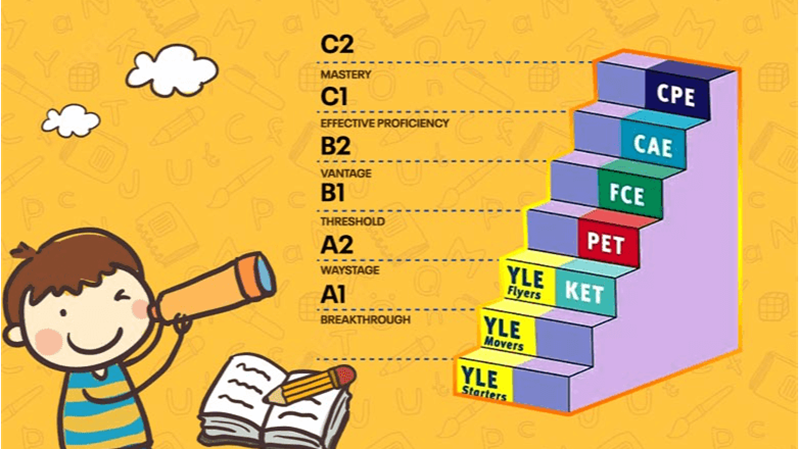
Each level has its own features to assess children’s English proficiency
Starters Level:
Starters is the first level in the Cambridge English Young Learners series for primary students. The Starters certificate is equivalent to Pre A1 on the
Common European Framework of Reference for Languages (CEFR).
The CEFR is a framework used to describe language proficiency levels. It provides common reference standards for teaching, learning, and assessing foreign languages.
Movers Level:
Movers is the second level in the Cambridge English Young Learners series. It is equivalent to A1 on the CEFR.
At this level, students can understand simple instructions, take part in basic real-life conversations about familiar topics, and write short texts in English, including information about time, dates, and places.
Flyers Level:
Flyers is the highest level in the Cambridge English Young Learners series. After achieving the Flyers certificate, students can move on to higher-level Cambridge exams such as KET and PET.
Flyers is equivalent to A2 on the CEFR. At this level, students can understand and communicate in English in many basic everyday situations, such as introducing themselves, discussing familiar topics, reading notices and instructions, and using simple phrases and sentence patterns to write short letters.
1.4 Cambridge certificate exam structure
Cambridge English exams for primary students are designed to assess children’s ability in the core language skills: Listening, Speaking, Reading, and Writing. Below is the exam structure for each level:
| Certificate | Listening | Reading & Writing | Speaking |
| Starters | 4 parts/ 20 minutes | 5 parts/ 20 minutes | 4 parts/ 3 - 5 minutes |
| Movers | 5 parts/ 25 minutes | 6 parts/ 30 minutes | 4 parts/ 5- 7 minutes |
| Flyers | 5 parts/ 25 minutes | 7 parts/ 40 minutes | 4 parts/ 7 - 9 minutes |
1.5 How Cambridge exam scores are calculated
Cambridge uses shield symbols on the certificate to show each child’s performance in the Starters, Movers, and Flyers exams. Children can receive up to 5 shields for each paper, with a maximum total score of 15 shields.
Although there is no official pass or fail result, a score of 10 shields or above is often considered a positive result. Each paper should also have at least 2 shields to show that the child has reached the corresponding level.
Children who achieve 11 or 12 shields or more may be ready to move on to the next level in the Cambridge English Young Learners series. If children do not reach the minimum number of shields, they can continue practising and improving their skills for the next exam.
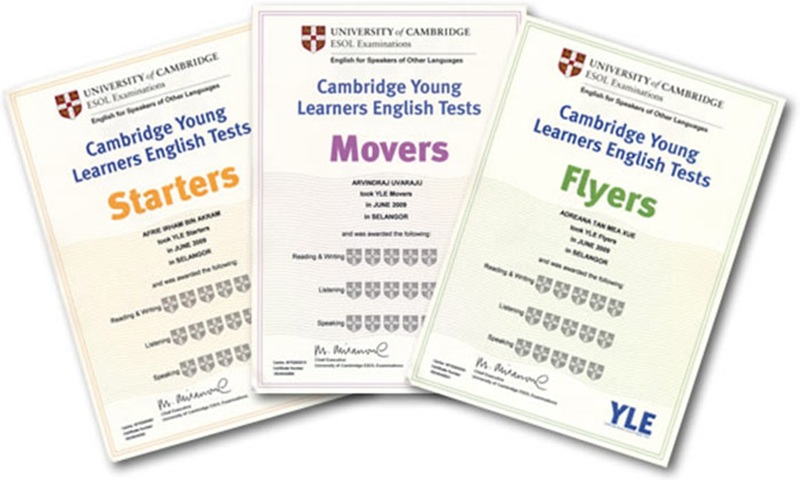
Cambridge exam results are shown through shield symbols
1.6 What should children prepare before taking the Cambridge YLE exam?
To prepare for the Cambridge YLE exams, including Starters, Movers, and Flyers, children need to review the required knowledge and become familiar with the exam format. In addition to mental and physical readiness, children should practise the key skills needed for the exam, including:
- Understanding and using vocabulary from the word list at their level.
- Spelling words from the vocabulary list correctly.
- Using the simple present and present continuous tenses correctly, such as understanding the difference between “I go” and “I am going.”
- Understanding prepositions of position, place, and time, such as identifying where people or objects are in a picture.
- Writing and spelling words they hear during the exam.
- Copying words to complete a short text in the test.
- Understanding and answering simple questions about pictures.
- Colouring according to the test instructions.
- Asking and answering simple questions.
All of these skills are important and should be reviewed carefully so children can achieve good results in the Cambridge YLE exam.
2. Why should children take Cambridge certificate exams?
There are several reasons why parents may consider Cambridge certificate exams for primary students. These exams not only help assess children’s English ability but also support their confidence, learning motivation, and future study pathway.
2.1 Becoming familiar with international-standard exams
Cambridge English exams are not only a way to assess children’s English proficiency but also an opportunity for them to become familiar with a professional international testing environment.
Each part of the Cambridge certificate exam is carefully designed and developed to meet international standards. By taking Cambridge exams, children can also gain experience, build confidence, and learn from other young learners.

Children can become familiar with international-standard exams
2.2 Inspiring children’s love for English
The main goal of Cambridge English exams for primary students is to encourage children’s interest and love for learning English. The exams are designed to be colourful, interactive, and fun, creating an enjoyable learning experience for young learners.
In addition, every candidate who takes the Cambridge exam receives a certificate. This serves as recognition of children’s learning efforts and gives them more motivation to continue practising English.
2.3 Assessing children’s English proficiency
Although the Cambridge Starters, Movers, and Flyers exams do not have pass or fail results, the number of shields on each certificate provides a reliable measure of children’s performance in each skill.
This helps teachers and parents identify children’s strengths and areas for improvement in English. Based on these results, schools can design suitable teaching methods and support plans to help children make better progress.
2.4 Guiding children’s English learning pathway more easily
Based on Cambridge exam results, parents and teachers can better understand children’s English ability, set suitable learning goals, and plan an appropriate learning pathway.
The results provide a clearer picture of children’s English proficiency. From there, parents and teachers can identify what children should focus on next and design a suitable development plan. This helps children progress with specific goals and develop their English ability more effectively.

Parents and teachers can plan a suitable learning pathway after assessing children’s English ability
2.5 Giving children access to better educational opportunities
Cambridge Starters, Movers, and Flyers certificates are recognised and accepted by more than 25,000 organisations, educational institutions, and schools in over 130 countries worldwide.
With this wide recognition, Cambridge certificates can become an important reference when children apply for advanced English classes, specialised schools, international schools, or multinational education programmes.
These certificates can also open up more opportunities for children in the future, including continuing to higher Cambridge qualifications, studying in international programmes, or exploring overseas education opportunities.
3. VAS – Paving the Way for Young Generations to Access Quality Education
With over 18 years of dedication to education, Vietnam Australia International School (VAS) has built its position as one of the leading international school systems in Vietnam. VAS supports students’ holistic development and gives them more opportunities to access quality education. Below are some key highlights of VAS.
3.1 International-standard learning environment
VAS provides an international-standard learning environment with modern facilities and a focus on global education standards.
From smart classroom designs that support modern teaching methods to investment in educational technology, VAS creates conditions for students to develop creative thinking and essential life skills.
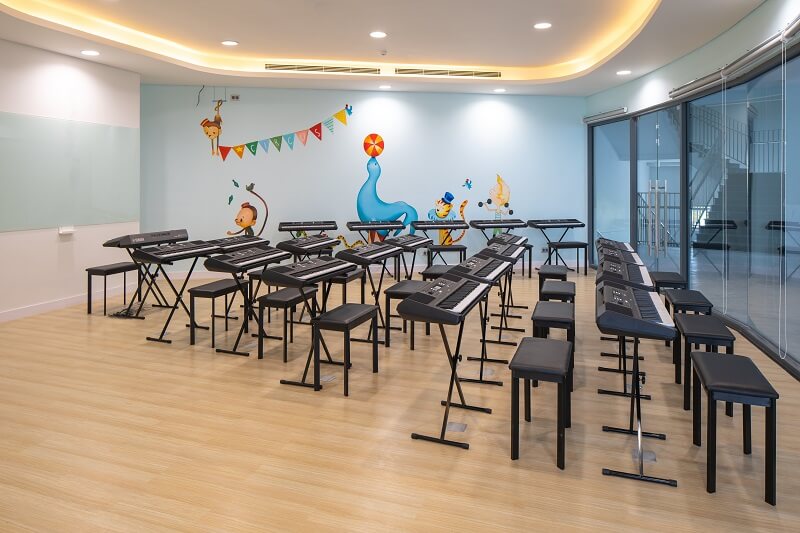
A modern music room at VAS Sala Campus
3.2 Professional teaching staff
VAS places strong importance on educational quality. Therefore, the school carefully selects its teachers and sets high standards to ensure that students are taught by qualified educators with strong professional knowledge and teaching skills.
In addition to regular international-standard training, VAS teachers actively update their knowledge and apply new educational approaches. The combination of professional expertise and teaching skills helps teachers create a creative learning environment that supports students’ development.

Vietnamese and international teachers at VAS are highly qualified and dedicated to students
3.3 Diverse learning pathways
With 4 learning pathways, VAS allows students to choose a suitable path based on their abilities and personal goals.
Pathway 1: Cambridge English Programme Standard (CEP Standard) and the National Education Programme (MOET)
- This pathway combines the Cambridge English Programme Standard with the Vietnamese National Education Programme. Students improve their English skills, vocabulary, and grammar while also gaining knowledge from the national curriculum.
Pathway 2: Cambridge English Programme Advanced (CEP Advanced) and the National Education Programme (MOET)
- This pathway is designed for students who want to further improve their English ability and reach a higher level of proficiency. Students continue developing their language skills while studying the national curriculum, helping them use English more confidently in international environments.
Pathway 3: Cambridge Academic Programme (CAP) and the National Education Programme (MOET)
- This pathway combines the Cambridge Academic Programme with the Vietnamese National Education Programme. Students study in a bilingual environment using both English and Vietnamese, which helps them develop communication skills and broaden their academic knowledge.
Pathway 4: Cambridge Academic Programme International (CAPI)
- This pathway provides a full international Cambridge learning experience. Students follow the Cambridge curriculum from Grade 1 to Grade 12, developing knowledge and skills based on international standards.
- This pathway also helps students become more independent in learning, think creatively, and build strong competence in key subjects.
Overall, by offering diverse learning pathways, VAS creates opportunities for students to develop holistically, not only in English but also in key subjects based on international standards.

At VAS, students are exposed to many practical and application-based subjects
3.4 Students can take Cambridge certificate exams at school
In addition to the strengths above, VAS is recognised as part of the Cambridge school system. This brings many benefits to students.
As a Cambridge school, VAS is authorised to organise Cambridge international exams and issue international certificates at school. This helps students save time and effort when preparing for and taking international exams.
VAS students can take Cambridge English exams such as Young Learners (YLE), Cambridge English: Key (KET), Cambridge English: Preliminary (PET), Cambridge English: First (FCE), Cambridge English: Advanced (CAE), Cambridge English: Proficiency (CPE), and other international certificates.
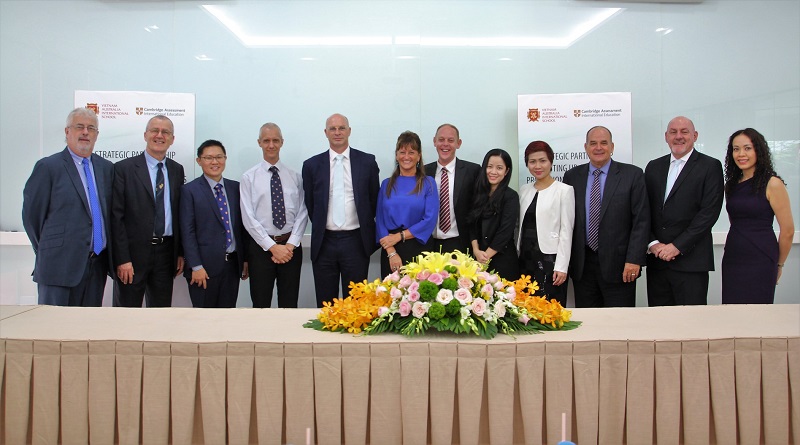
VAS also works with Cambridge to establish the CAIE Training and Professional Development Centre in Vietnam
>>> Read more: Discover in detail the current tuition fees for VAS bilingual preschool
4. Conclusion
With an international-standard learning environment, professional teaching staff, and 4 diverse learning pathways, VAS gives students opportunities for holistic learning and development, from English proficiency to a deeper understanding of international education pathways.
Vietnam Australia International School (VAS) is considered one of the leading international school systems in Ho Chi Minh City, helping young generations access quality education and prepare for the future.
If you are interested in the international education programme at VAS, please contact us via hotline 0911 26 77 55 or visit www.vas.edu.vn for detailed consultation.
>>> Read more:
Cambridge International Programme: Key Things Parents Should Know
List of 21 high-quality international bilingual schools in Ho Chi Minh City