



7 Secrets to Developing Public Speaking Skills for Elementary School Children
- Why do elementary school children need to develop public speaking skills?
-
7 secrets to effectively teaching public speaking skills to elementary school children
- 2.1 Teaching children about presentation tools
- 2.2 Teaching children to prepare presentations
- 2.3 Teach children to practice before their presentations
- 2.4 Teach children how to incorporate vivid examples and humorous stories into their presentations.
- 2.5 Teach children to use body language when giving presentations.
- 2.6 Show children plenty of engaging presentation videos.
- 2.7 Create opportunities for children to interact more with crowds.
- Effective public speaking skills - A strength of VAS students.
In a study by an educational and business organization published in Forbes, 70% of managers stated that effective public speaking skills are one of the critical factors in becoming an outstanding leader. Therefore, more and more schools are focusing on training children in presentation skills from an early age to build the foundation of a global citizen and a future leader. To help children become confident, bold, and persuasive speakers, parents need to accompany the school to provide maximum support in developing their child's presentation skills.
In the article below, let's explore with VAS the 7 secrets to effectively developing public speaking skills for elementary school children, so parents can have specific guidance steps for their kids!

Public speaking skills are something elementary school children need to practice
1. Why do elementary school children need to develop public speaking skills?
Presentation skills refer to the ability to convey ideas and information logically, clearly, and persuasively to the audience the speaker wants to reach. Using words and supporting tools, the speaker must ensure the audience clearly understands what is being presented, solves a certain problem, or gains new knowledge.
Parents should not think that only public figures who frequently speak in front of a crowd need to practice presentation skills. Every child needs to develop public speaking skills because this brings many important values, such as:
- Helping children become more confident in themselves.
- Improving children's communication skills.
- Discovering children's personal potential.
- The process of thinking and preparing for a presentation helps improve children's writing and language usage skills, especially grammar.
- Facilitating their transition to higher levels of education and giving them confidence when stepping into the real world.
- Developing sharp and logical thinking: The process of preparing and delivering a presentation requires elementary school children to think logically, organize information, and build appropriate arguments. This helps children develop critical thinking, sharpness, and the ability to analyze problems.
- Developing social skills: Presentation skills require elementary school children to interact and work in teams. During the preparation and presentation process, children must cooperate, listen to others' opinions, and know how to express their views persuasively. This helps children develop social skills, learn to present their thoughts and opinions, while also cooperating and respecting others' perspectives.
- A solid foundation for the future: Effective presentation skills are a crucial foundation for children to achieve success in academics as well as in their future career development. Elementary school children who practice public speaking skills early on will have an advantage in confidently expressing themselves, presenting personal opinions, persuading others, and communicating confidently. Thus, they have the opportunity to achieve more success both now and in the future.
From the above benefits, it can be seen that effectively training public speaking skills for elementary school children brings many important benefits for personal development and prepares a solid foundation for the future.

Children participating in diverse activities at school have many opportunities to practice effective presentation skills
2. 7 secrets to effectively teaching public speaking skills to elementary school children
Up to 75% of people say they are afraid of speaking in front of a crowd. It can be seen that presenting is a fear for many, but it is a common and necessary activity throughout school and into working life. Therefore, presentation skills can be a weakness but also a "weapon" everyone wants to possess. To help children approach presentations naturally and reduce their fear, parents need effective training secrets for them. Below are the 7 most popular methods, let's explore them!
2.1. Teaching children about presentation tools
Currently, there are various presentation applications and software such as Canva, Google Slides, Powtoon, etc. However, among them, PowerPoint from the Microsoft Office suite is the most popular and useful tool. Therefore, parents can teach children how to prepare content and use PowerPoint during the presentation process. For elementary school children, they only need to understand basics like creating a new slide, saving and reopening a saved file, as well as simple operations with text, shapes, and images. If the child has mastered these steps, parents can also introduce animations and transitions.
In addition, when teaching presentation skills to children, parents can also guide them to use other tools like whiteboards, posters, large A0 paper, blackboards, notebooks, or projection tools to highlight key points in the presentation. Each of these tools has its own advantages. Therefore, based on the child's goals and skills, parents should guide them to choose the right tool to enhance the effectiveness of their presentation.
2.2. Teaching children to prepare presentations
During the process of training public speaking skills for elementary school children, guiding them to prepare the presentation content is extremely important. Therefore, parents should share the following key points with their children:
First, the child needs to identify the audience for the presentation. This is the most important step that children need to do from the beginning for the presentation to be effective. Many children often feel shy when standing in front of a crowd because they have not been thoroughly trained and lack experience. Therefore, parents should guide the child on how to connect with the audience to make the presentation more effective. To interact well with the listeners, the child must first understand who their audience is, what they need from the presentation, etc. Thanks to this, the child will feel the audience is closer and easier to connect with. Moreover, clearly identifying the audience also helps the child choose the right topic and presentation style.
Second, the child needs to choose the presentation content. The content of the presentation will depend on the selected topic. It needs to be presented clearly and in detail. Parents should suggest that the child not choose a topic that is too broad, as this will make the content preparation unfocused and rambling. Instead, guide the child to choose a narrower scope to present.
Finally, the structure of the presentation is also very important. It relates to the amount of content and the presentation time. For elementary school children, parents should guide them to prepare a presentation with about 8-10 PowerPoint slides and a presentation time of about 10-15 minutes. Show the child how to choose the font, text color, font size, etc., so that it is clear and easy to read. At the same time, guide the child to select illustrations that match the content.
Thus, to prepare an effective presentation, elementary school children need careful preparation, clear identification of the listening audience, and focus on the presentation content with a clear structure.
2.3. Teach children to practice before their presentations
Before the child steps into the presentation, parents need to help them practice their public speaking skills so they can be more confident and grasp the parts they will talk about. Here are some ways parents can help their child practice before the presentation:
- Practice speaking in front of a mirror: Guide the child to stand in front of a mirror and deliver the presentation as if presenting to the public. This helps the child get used to being confident and expressing opinions in front of others.
- Organize a family presentation rehearsal: Create a small family presentation session where the child will present their content to parents and siblings. Family members will act as the "audience," listening and providing positive feedback after the presentation to help strengthen the child's presentation in the best way. This also helps the child practice interacting and responding to the "audience."
- Practice presenting to friends: Invite some of the child's friends over and let the child deliver the presentation. This not only helps the child get used to presenting in front of a crowd but also helps them receive encouragement and feedback from friends.
- Record a presentation video: Use a mobile phone or camera to record the child's presentation process. Afterward, parents and the child can review it, self-evaluate, and improve from there.
By practicing before the presentation, the child will feel more confident, mastering their content and presentation style. At the same time, the child also has the opportunity to practice communication skills, interact with the audience, and adapt when standing in front of a crowd.

Parents need to help children practice presenting in front of a crowd so they can be more confident
2.4. Teach children how to incorporate vivid examples and humorous stories into their presentations.
Besides presenting the right content, children can also incorporate real-life examples and humorous stories to make their presentation more vivid. This not only brings a sense of comfort to the speaker and the audience but also creates a memorable impression of the presentation. Here are some methods to help children integrate examples and funny stories into their presentations:
- Find real-life examples: Parents can guide the child to find real-life examples related to the presentation topic. This helps the child illustrate and clarify abstract concepts through real-life situations. The child can use examples from daily life or from books and movies they are interested in.
- Create humorous stories: Encourage the child to create a humorous story related to the presentation content. The child can tell about funny situations they have experienced or imagine a hilarious story. A humorous story will make the presentation more interesting and capture the audience's attention.
- Use images and charts: Guide the child to use images and charts to illustrate and clarify points in the presentation. Images can be illustrations, drawings, or graphs. The child can create funny images or use an hourglass chart to add interest to the presentation.
- Use emotional statements: Children can use touching statements to evoke emotions and create a connection with the audience.
2.5. Teach children to use body language when giving presentations.
Using body language is a way to help children stay confident and control their presentation. Using gestures, eye contact, and showing agreement by nodding are elements that help children create connections and communicate effectively with the audience. From there, the child will attract the listeners' attention and bring success to the presentation.
To guide children to use effective public speaking skills through body language, the following methods can be applied:
- Be confident and shine: Guide the child to be confident in expressing body language. The child should stand straight and look directly at the audience. Flexible hand gestures, natural eye contact, and a friendly smile will help the child create a connection with the audience.
- Express and adjust tone: Encourage the child to use facial expressions and gestures to convey opinions and bring the presentation to life. At the same time, the child also needs to adjust their tone of voice, keeping it clear and expressive, suitable for the presentation content.
- Pay attention to the audience's body language: Guide the child to observe the audience's reactions and respond flexibly. If the audience does not understand or is not interested, the child can change their delivery style and use body language to capture their attention.
- Practice and feedback: Encourage the child to practice using body language in a safe environment like home or the classroom. After each presentation, parents or teachers can provide feedback and suggestions for the child to improve their body language skills.
Through guiding the child to use body language, they will become confident and attract the audience's attention during the presentation process.
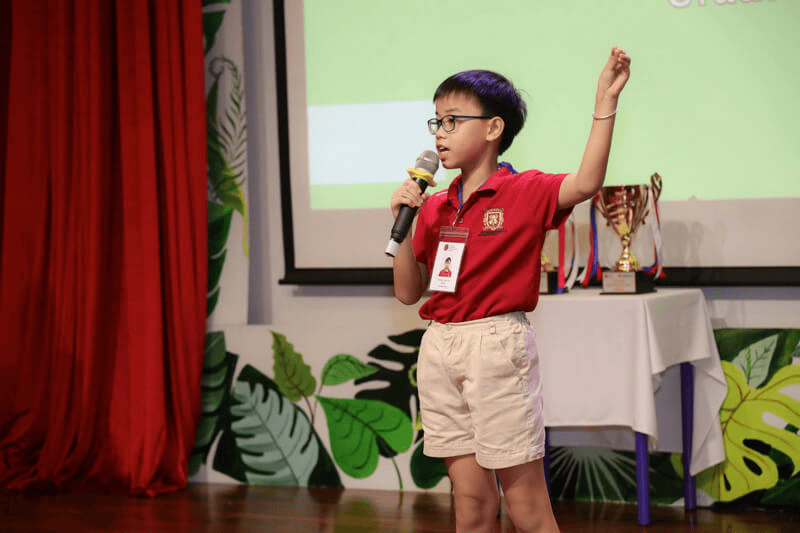
Guide children to use body language when presenting
2.6. Show children plenty of engaging presentation videos.
One secret to training presentation skills for children is to let them watch many engaging presentation videos. Young children have the ability to imitate and learn very quickly. Therefore, watching tutorial videos will help them learn the gestures and postures when presenting, which they can then apply to their own presentations vividly. Here are some guidelines to effectively utilize the secret of watching videos:
- Choose appropriate videos: Select presentation videos aimed at children or those of the same age so the child can easily absorb and understand the content. Videos should be carefully selected, high-quality, and highly educational.
- Stimulate curiosity: Before watching the video, encourage the child to ask questions or think about the topic to be presented. This helps build curiosity and increases focus while watching.
- Observe and analyze: While watching the video, encourage the child to pay attention to important elements like the speaker's gestures, tone, and facial expressions. Afterward, the child can discuss and analyze how the speaker creates an impression and impacts the audience.
- Practice by modeling: After watching the video, encourage the child to try practicing presenting by mimicking the speaker in the video. The child can practice presenting with family, friends, or even alone to hone their public speaking skills.
- Games and discussions: Use presentation videos as a basis for games or discussion activities about the content and presentation techniques. This helps the child practice communication skills, logical thinking, and analytical abilities.
By watching many engaging presentation videos, the child will have the opportunity to learn and draw inspiration from great speakers, thereby improving their own presentation skills.
2.7. Create opportunities for children to interact more with crowds.
Letting children interact with crowds is the way to help them become bolder and more confident. Interacting with crowds helps children practice listening and speaking skills, learn how to interact with others, and from there, they will learn how to present ideas clearly, logically, and persuasively. Furthermore, talking to people will help children discover new ideas, perspectives, and knowledge, thus creating diversity and expanding their knowledge. Here are some suggestions parents can implement to help children interact with crowds:
- Group activities: Organize group activities for the child, such as discussions, group presentations, mock speaking, or presentation contests. This helps the child get used to speaking in front of a group of people and practice communication and presentation skills in a team environment.
- Performances: Let the child participate in performances, plays, or other showcase events at school or in the community to hone their confidence and fluency in expressing ideas.
- Join clubs and organizations: Encourage the child to join clubs or organizations such as speaker clubs, presentation clubs, literature clubs, or presentation competition groups. This is a place where the child can practice presentation skills, exchange opinions, and learn from those with the same passion.
- Participate in presentation contests: Encourage the child to participate in school-level or local presentation contests. By joining contests, the child will have the opportunity to practice presenting, receive feedback and evaluations from others, and improve their skills over time.
- Real-life experiences: Create opportunities for the child to participate in real-life activities and events, such as joining family meetings, attending friends' birthdays, or taking part in charity activities. Interacting and communicating with many people will gradually build boldness, helping the child overcome their shyness.

Encourage children to participate in many presentations to boost their confidence
>>> Learn more: 7 Effective ways to teach children communication skills
3. Effective public speaking skills - A strength of VAS students.
More than anyone, VAS clearly understands the importance of presentation skills for elementary school children. Therefore, VAS always focuses on training children's confident presentation abilities through active learning methods and many engaging extracurricular activities, creating opportunities for children to "learn by doing."
At VAS, children are encouraged to develop their public speaking skills fluently and effectively in both English and Vietnamese. Children are guided through complete sample presentations, and teachers encourage them to do it their own way. Children can reference presentation videos, and then the whole class will discuss and analyze the good and not-so-good points to draw valuable experiences. Through presentation classes, children will get to:
- Use English to present professionally with a confident, comfortable, and natural demeanor.
- Practice using rich and flexible vocabulary to express their opinions clearly and logically.
- Improve persuasion skills as well as develop sharp critical thinking.
In addition, VAS regularly organizes presentation contests and useful activities such as the "Let's join hands to protect the environment around us" presentation contest, English Speaking contest, VASers for the community (VAS Community), scientific research competitions, or Good Book Sharing seminars... The contests not only help students review lessons and expand their knowledge but also serve as a fun playground to hone their confidence when presenting in front of a crowd. The contests are also a place where students can interact, learn presentation experiences from one another, and build team spirit by supporting and coordinating with each other to deliver the best performance.
Here, the children will be guided by teachers to collect and flexibly use persuasive evidence on a specific topic. Thanks to this, students not only show excellent abilities in effective presentation but also enhance their confidence, stage mastery, and sharp critical thinking. It can be said that the educational program at VAS has created a favorable environment to "nurture" the outstanding public speaking talents of future leaders.
>>> Learn more: Detailed updates on tuition fees for each study program at VAS
Above are the secrets to effectively developing presentation skills for elementary school children that parents can apply. Hopefully, this useful information will give parents a good guide in teaching their children public speaking skills, thereby encouraging them to be proactive, confident, and professional when presenting in front of a crowd.
To learn more about the study programs, life skills development activities for children, and teaching methods currently applied at VAS, parents can contact our consulting team via hotline 0911 26 77 55 for support.