


Top 5 extracurricular classes to develop critical thinking skills in elementary school for children
Today, parents are increasingly prioritizing extracurricular classes that foster holistic development. These programs offer more than academic learning; they are environments where children sharpen creativity, communication, and problem-solving skills. VAS introduces the top 5 extracurricular options that develop critical thinking for elementary students, helping parents make informed decisions for their child’s future.
1. Is Elementary School the Golden Age for Developing a Child's Thinking Skills?
Educational experts and neuroscientists identify the elementary years (ages 6 to 12) as a critical stage for cognitive development. This is not merely a phase of rapid growth, but a critical "window of opportunity" where the brain structure develops rapidly.
To understand why extracurricular classes are so effective during this period, we must look at the biological and psychological milestones:
According to research from Harvard University’s Center on the Developing Child, the brain at this age is highly adaptable and responsive to learning experiences. Activities like Math Thinking or Chess help "wire" the brain for logic, making these pathways permanent and efficient.
Moreover, based on Jean Piaget’s Theory of Cognitive Development, children in this age group transition into the "Concrete Operational Stage." They begin to think logically about concrete events, making it the perfect time to introduce structured extracurricular activities that challenge their reasoning.
So, investing in a child's development during this stage provides long-term educational benefits:
- Cognitive Foundation: Enhances the working Memory and attention span, which are fundamental for academic excellence.
- Language Acquisition "Prime Time": Linguistics research shows that the brain is most receptive to the phonetic and grammatical structures of a second language before the onset of puberty.
- Social-Emotional Intelligence (SEL): Beyond IQ, these years are vital for developing empathy and collaborative skills through group-based extracurriculars.
Regular stimulation helps strengthen brain development during childhood. Providing diverse stimuli through extracurricular classes during the primary years ensures that the neural circuits for logic and creativity are strengthened for a lifetime.

From ages 6 to 12, a child's brain has the ability to absorb knowledge naturally and easily
2. Are Extracurricular Classes Expensive?
The cost of extracurricular classes for elementary students varies significantly, ranging from budget-friendly options to premium programs. Whether these classes are considered "expensive" depends on several key factors that influence tuition fees:
Subject Matter & Resource Requirements:
- Subjects like Math Thinking, Chess, and Foreign Languages often have lower fees as they require fewer specialized tools.
- In contrast, Musical Instruments or Advanced Public Speaking typically cost more due to the need for high-end facilities, specialized equipment, and elite instructors.
Duration & Learning Format:
- Course Length: Options range from short-term workshops (a few weeks) to long-term year-round programs. While long-term courses require a higher total investment, they ensure more consistent progress for the child.
- Learning Mode: Online classes are often more cost-effective as they eliminate facility overhead and commuting expenses, whereas in-person learning provides direct interaction but at a higher price point.
However, when evaluating costs, parents should consider the Long-term Value. While some programs may have higher upfront fees, the long-term value is substantial. These classes do not just provide knowledge; they build life skills, problem-solving capabilities, and self-confidence, essential assets for a child's future success.
Investing in quality education, though potentially costly at first, yields sustainable benefits by fostering holistic development and long-term achievements.
To make quality education more accessible, many centers now offer:
- Scholarships & Incentives: Tuition discounts, monthly payment packages, and sibling incentives to fit various family budgets.
- Trial Experiences: Free or low-cost trial sessions that allow parents and students to evaluate the program’s quality before making an official commitment.
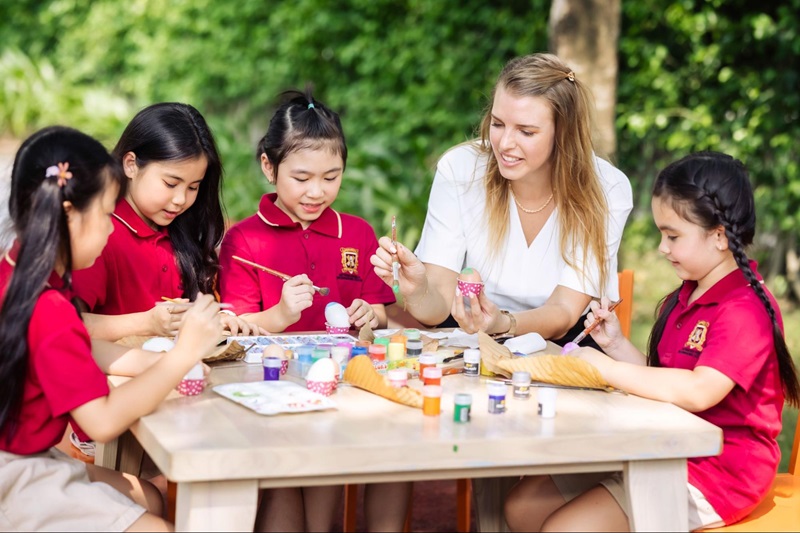
Extracurricular classes that develop thinking not only help kids gain more knowledge but also form life skills
3. 5 Extracurricular Classes to Develop Children's Intellectual Thinking
As children enter the elementary stage, participating in extracurricular classes becomes an effective strategy for cognitive and intellectual growth. Below are 5 noteworthy options that foster thinking abilities, creativity, and essential life skills:
3.1. Math Thinking Skills Class
Math thinking programs focus on developing analytical and problem-solving skills through logical puzzles and creative reasoning exercises. These classes go beyond standard arithmetic to stimulate the brain, building a child's confidence when tackling complex challenges.
- Impact: Enhances logical deduction and abstract reasoning.
- Reference Tuition: 1 - 2 million VND/month (basic) to 3 - 5 million VND/month (intensive or native instructors).

A math thinking skills class helps kids develop analytical and problem-solving abilities
3.2. Chess Class
Chess is one of the most effective activities for developing strategic thinking. Through every match, children learn to plan ahead, anticipate opponent moves, and manage unexpected situations—making it one of the most popular extracurricular classes for primary students.
- Impact: Sharpens foresight, patience, and tactical analysis.
- Reference Tuition: 500,000 - 1 million VND/month (basic) to 2 - 3 million VND/month (advanced).
3.3. Foreign Language Classes
Acquiring a new language does more than facilitate communication; it supports brain development. Learning a foreign language encourages children to develop logical structures while adapting to diverse grammatical frameworks.
- Impact: Boosts cognitive flexibility and cross-cultural awareness.
- Reference Tuition: 1.5 - 3 million VND/month (8 - 12 sessions) to 5 - 6 million VND/month (premium or 1-on-1 with native teachers).
3.4. Instrument Classes
Learning an instrument is a great way to support brain development. Scientific research indicates that musical training can significantly improve concentration, long-term memory, and creative expression.
- Impact: Synchronizes left and right brain hemispheres and refines fine motor skills.
- Reference Tuition: 2 - 4 million VND/month (4 - 8 sessions) to 5 - 8 million VND/month (high-level instructors or premium instruments).
3.5. Public Speaking Class
Public speaking helps children develop strong communication skills, the confidence to present personal ideas, and the ability to persuade others—vital traits for future personal and professional leadership.
- Impact: Improves verbal fluency, body language, and critical thinking.
- Reference Tuition: 1.5 - 3 million VND/month (8 - 12 sessions) to 4 - 6 million VND/month (intensive specialized courses).

Tuition for a public speaking class ranges from 1.5 - 3 million VND/month
4. Are Extracurricular Activities Integrated into International School Curricula?
In top-tier international schools, extracurricular classes are not merely add-ons; they are strategically integrated into the academic program. This holistic approach ensures students apply theoretical knowledge to practical situations, fostering creativity, teamwork, and critical problem-solving skills.
As a pioneer in the "integrated curriculum" model, VAS ensures children develop both thinking skills and life skills through:
- Diverse Course Offerings: VAS provides a rich spectrum of clubs, including Math Thinking, Chess, Foreign Languages, Musical Instruments, and Public Speaking, designed to help students discover their personal passions.
- High-Caliber Faculty: Classes are led by highly qualified specialists who provide deep subject knowledge and an enriched learning environment.
- Seamless Integration: At VAS, extracurriculars are woven into daily education. For instance, Chess is not just a game; it helps students practice strategic thinking, while Public Speaking is integrated into classroom presentations.
- Periodic Milestone Events: The school frequently organizes workshops, professional seminars, and art showcases, giving students a stage to demonstrate their growth and learn from their peers.
>>> Read more: Details about extracurricular activities at VAS
5. Conclusion
Enrolling your child in extracurricular classes is a strategic investment in their "Golden Age" of development. These programs provide a dynamic and creative environment where children can expand their worldviews and prepare for future global challenges. By choosing the right extracurricular path today, you are building a solid foundation for your child's lifelong success.
If you are interested in the international education programs at VAS, please contact us for personalized advice:
- Hotline: 0911 26 77 55
- Website: www.vas.edu.vn
>>> You may also like: 8 talent subjects to help kids develop comprehensively