


Effective Mathematical Thinking Exercises for 5-Year-Olds
- What are mathematical thinking exercises for 5-year-olds?
-
8 outstanding benefits of mathematical thinking exercises for 5-year-olds
- 2.1 Developing logical thinking and cognitive responses
- 2.2 Improving memory and concentration
- 2.3 Developing problem-solving skills from an early age
- 2.4 Stimulating creativity and flexible thinking
- 2.5 Supporting better math learning in primary school
- 2.6 Enhancing language skills and verbal reasoning through word problems
- 2.7 Helping children enjoy learning from an early age
- 2.8 Building a foundation for future STEM learning
-
Typical types of mathematical thinking exercises for 5-year-olds
- 3.1 Quantity and order exercises
- 3.2 Shape recognition and spatial thinking exercises
- 3.3 Sorting and classification exercises
- 3.4 Pattern, logical sequence, and missing-number exercises
- 3.5 Simple word problems
- 3.6 Mazes, puzzles, and connect-the-dots activities
- 3.7 Math games with dice, sticks, number cards and real objects
- 3.8 Memory and observation exercises
-
Effective methods for teaching mathematical thinking to 5-year-olds at home
- 4.1 Learning through games and visual activities
- 4.2 Using real objects in daily lessons
- 4.3 Giving step-by-step guidance and asking open-ended questions
- 4.4 Using selective repetition to reinforce knowledge without boredom
- 4.5 Creating a positive, pressure-free learning environment
- 4.6 Supporting concentration and thinking through proper nutrition
- Vietnam Australia International School (VAS) – Learning mathematical thinking through a modern preschool programme
- Conclusion
Between the ages of 4 and 6, children begin to develop their early thinking skills and show strong learning ability when guided with suitable methods. Mathematical thinking exercises for 5-year-olds not only help children become familiar with numbers and shapes but also support brain development, problem-solving skills, memory, and concentration.
So, what do mathematical thinking exercises for 5-year-olds include? How can parents design these activities so children can learn effectively through play?
1. What are mathematical thinking exercises for 5-year-olds?
Mathematical thinking exercises for 5-year-olds are learning activities designed based on the cognitive characteristics of preschool children. These exercises help children develop logical thinking, observation, reasoning, and information analysis skills.
They are not dry calculations. Instead, they combine learning and play through pictures, real objects, and interactive games, helping children understand math more easily and feel more interested in learning.
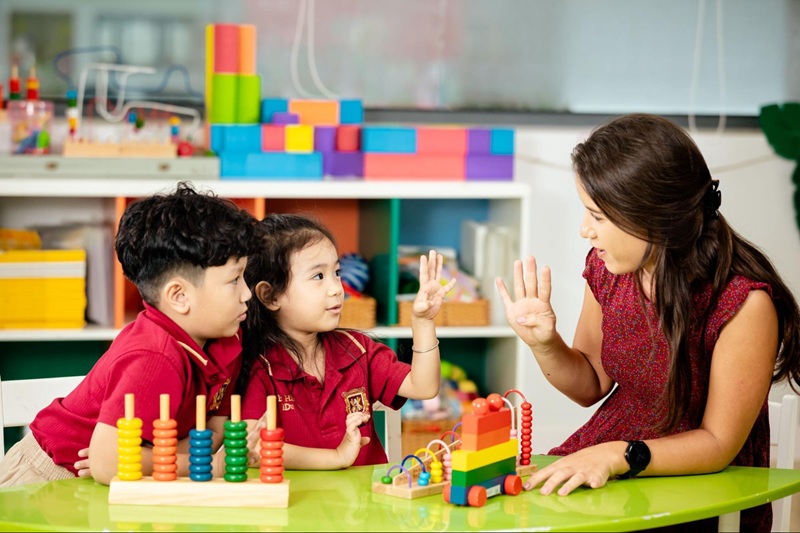
Mathematical thinking exercises for 5-year-olds are often designed as engaging thinking games
Mathematical thinking exercises for 5-year-olds usually include:
- Recognizing shapes and colors: Children become familiar with squares, triangles, and circles through activities such as matching, coloring, and identifying shapes.
- Counting and simple calculations: Children learn to count objects and become familiar with addition and subtraction within the range of 5 to 20, using familiar items such as candies or crayons.
- Comparing and sorting: Children learn concepts such as big and small, long and short, more and less, then group objects based on specific criteria.
- Finding patterns and filling in missing numbers: These exercises help children identify patterns in number sequences, pictures, or colors and predict what comes next.
- Word problems: Simple situations such as “Lan has 3 cakes, and her mother gives her 2 more. How many cakes does Lan have in total?” help children solve problems through language.
- Mazes, connect-the-dots, and path-finding activities: These activities help develop spatial awareness, patience, and reasoning skills.
- Coloring and drawing shapes based on models or numbers: These exercises help children practise hand-eye coordination and fine motor skills while learning numbers.
These exercises help children practise concentration, strengthen memory, and develop communication skills by explaining how they solve each task.
More importantly, mathematical thinking at the age of 5 is not about training children to become prodigies or solve difficult problems quickly. Its main purpose is to activate flexible thinking and help children build a strong foundation for long-term learning, especially in mathematics and applied science.
2. 8 outstanding benefits of mathematical thinking exercises for 5-year-olds
Introducing children to mathematical thinking from an early age can bring many benefits beyond basic arithmetic. This approach is used in many developed countries to help support children’s overall intellectual development.
2.1. Developing logical thinking and cognitive responses
Mathematical thinking helps children learn how to reason, analyze, and draw conclusions based on what they observe. When working on pattern, sorting, or missing-number exercises, children use logic to find the answer.
This can stimulate brain areas related to critical thinking and help children respond to situations more quickly.
2.2. Improving memory and concentration
Solving mathematical thinking exercises requires children to observe, remember information such as quantity, shape, order, and color, and then process it in their minds.
Repeating this process regularly can help children improve short-term memory and gradually increase concentration in other activities.
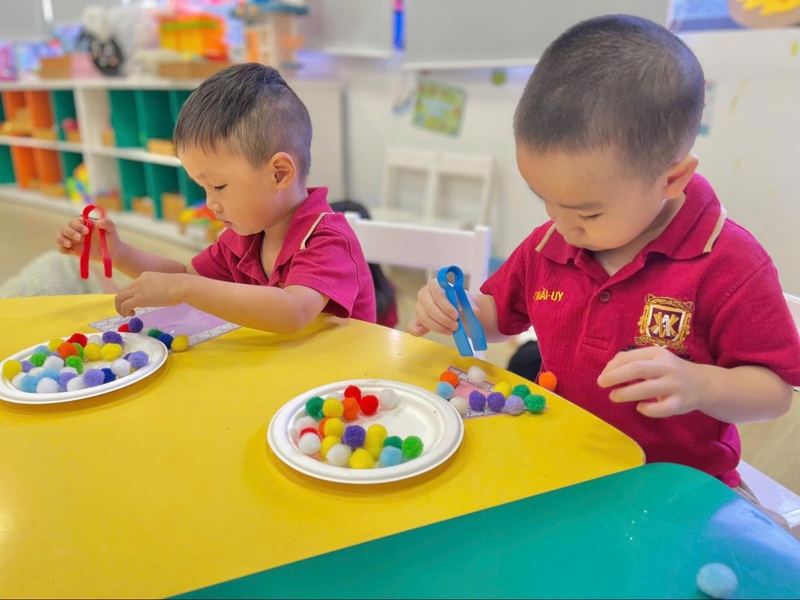
Playing games that require focus helps children maintain attention for longer
2.3. Developing problem-solving skills from an early age
When children face a mathematical thinking exercise, they learn how to analyze the task, make guesses, and try different ways to solve it. This skill is not only useful in math but can also be applied in daily life, helping children learn how to find solutions when they face difficulties.
2.4. Stimulating creativity and flexible thinking
Unlike fixed learning tasks, mathematical thinking exercises often allow children to approach problems in different ways. Children can try, make mistakes, and create their own ways of solving problems. This helps them develop open thinking and avoid being limited to one familiar method.
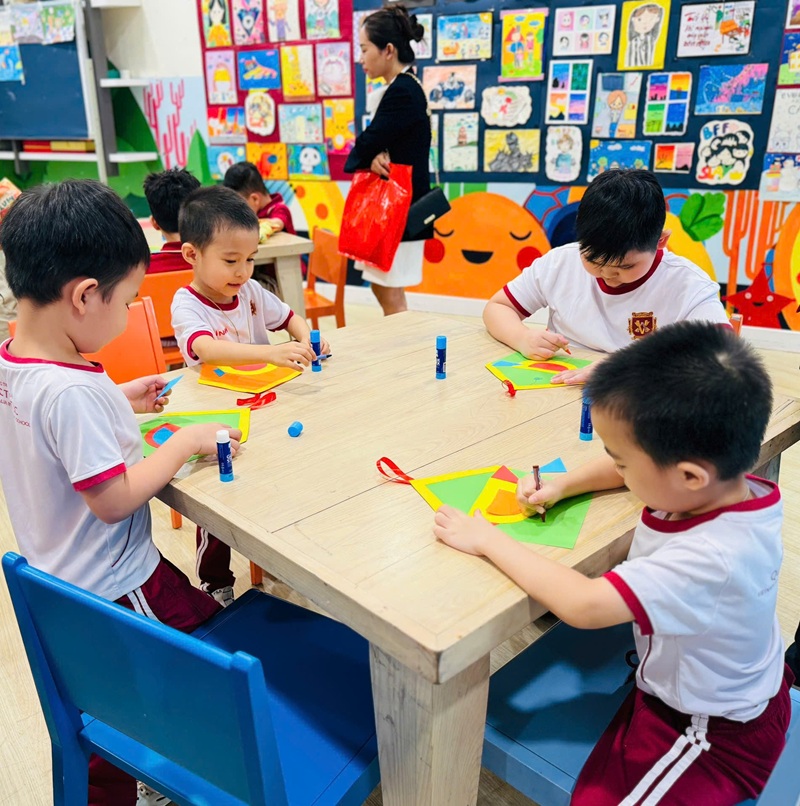
Thinking activities for 5-year-olds encourage children to be creative and think in different ways
2.5. Supporting better math learning in primary school
Children who build a foundation in logical thinking, counting, geometry, and mathematical language can approach Grade 1 math more easily and with less confusion. This can help children feel more confident, enjoy math more, and achieve better learning results in the early years of primary school.
2.6. Enhancing language skills and verbal reasoning through word problems
Math is not only about numbers. Word problems require children to understand a situation, analyze the wording, and explain their answers. This gives children opportunities to develop reading comprehension, expression, and verbal thinking, which are important skills for long-term learning.
2.7. Helping children enjoy learning from an early age
When children learn through games, colorful visuals, and familiar activities, they do not feel forced to study. Instead, they can see math as an interesting discovery game. Solving a challenge can also help children feel more confident and interested in learning.
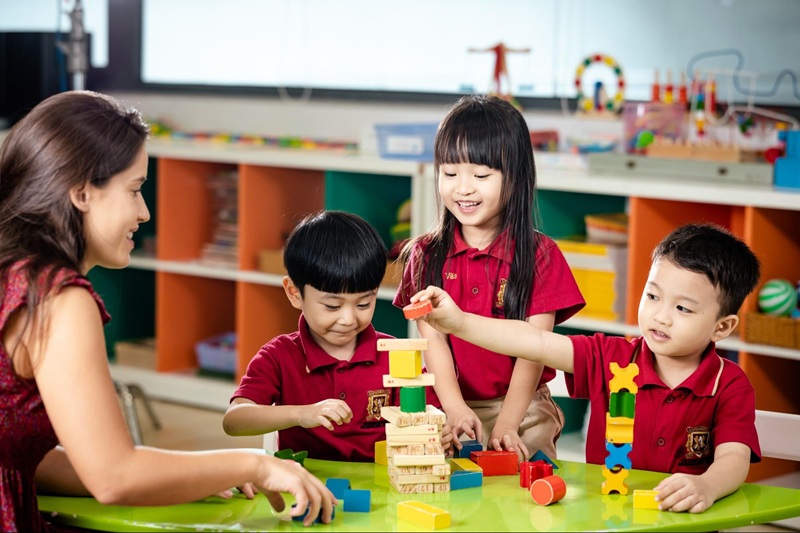
Children enjoy learning more when lessons are designed as games
2.8. Building a foundation for future STEM learning
Mathematics is one of the four core areas of STEM: Science, Technology, Engineering, and Mathematics. Early exposure to mathematical thinking can help children develop analytical and scientific thinking, which are important foundations for learning engineering, programming, robotics, and applied sciences later on.
3. Typical types of mathematical thinking exercises for 5-year-olds
Mathematical thinking for 5-year-olds is not limited to counting numbers or recognizing shapes. Exercises that are designed based on children’s developmental characteristics can help build a foundation for math learning and thinking skills later on.
3.1. Quantity and order exercises
This basic type of exercise helps children become familiar with numbers and order. Children can start by counting from 1 to 10, then gradually move up to 20 or higher. These exercises can also include comparing bigger and smaller numbers, identifying equal quantities, and arranging numbers in ascending or descending order.
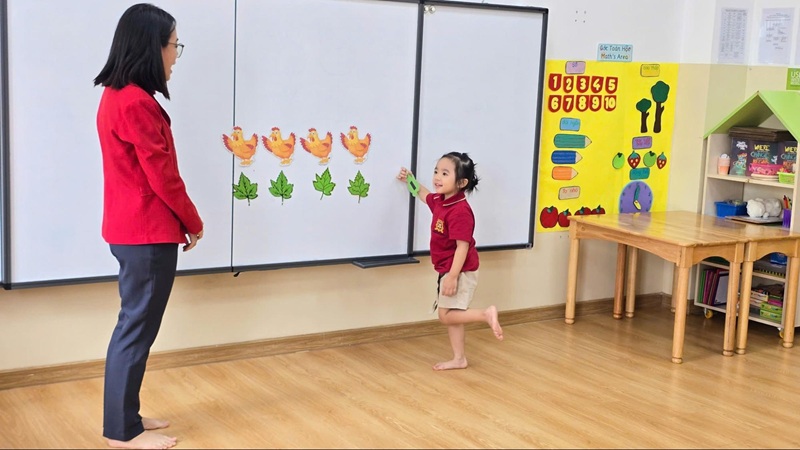
Through games, children learn how to count and compare quantities
3.2. Shape recognition and spatial thinking exercises
Children are introduced to basic shapes such as circles, squares, triangles, and rectangles. Through shape matching, 2D puzzles, and simple 3D building activities, children can develop spatial thinking, learn to recognize directions, and improve visual reasoning.
3.3. Sorting and classification exercises
This type of exercise helps children observe and distinguish features such as color, size, shape, and quantity. Children sort objects based on similarities or differences, which helps develop their ability to analyze and organize information.
3.4. Pattern, logical sequence, and missing-number exercises
Children become familiar with picture or number sequences that follow a pattern, such as 2, 4, 6, and so on. They need to observe, identify the rule, and complete the sequence. This type of exercise helps activate logical thinking and sequential reasoning.
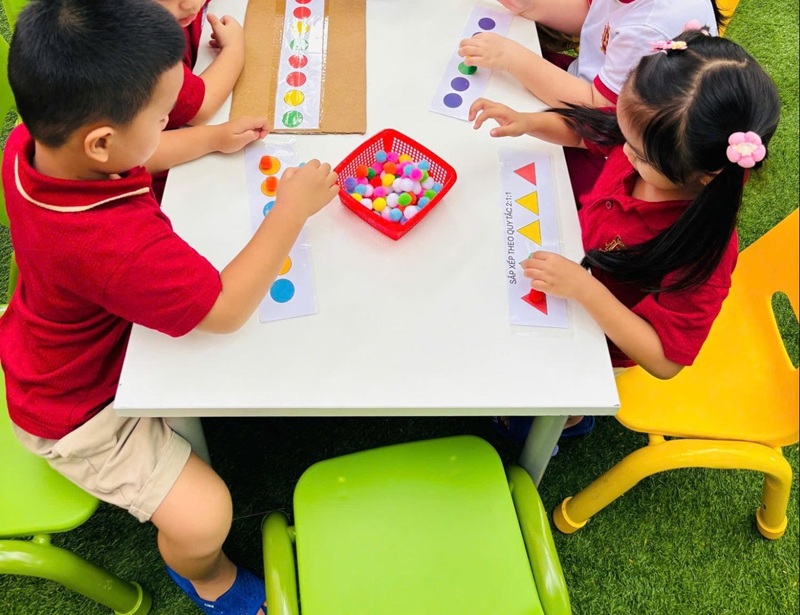
Pattern sequence exercises help children think logically
3.5. Simple word problems
This type of exercise requires children to understand a situation presented in a short story and then find the answer. For example: “Lan has 3 apples, and her mother gives her 2 more. How many apples does Lan have in total?” Word problems help children develop both language thinking and mathematical thinking.
3.6. Mazes, puzzles, and connect-the-dots activities
Visual activities such as connecting dots by number, finding the way out of a maze, and placing puzzle pieces in the correct position help children practise observation, geometric reasoning, and flexible thinking.
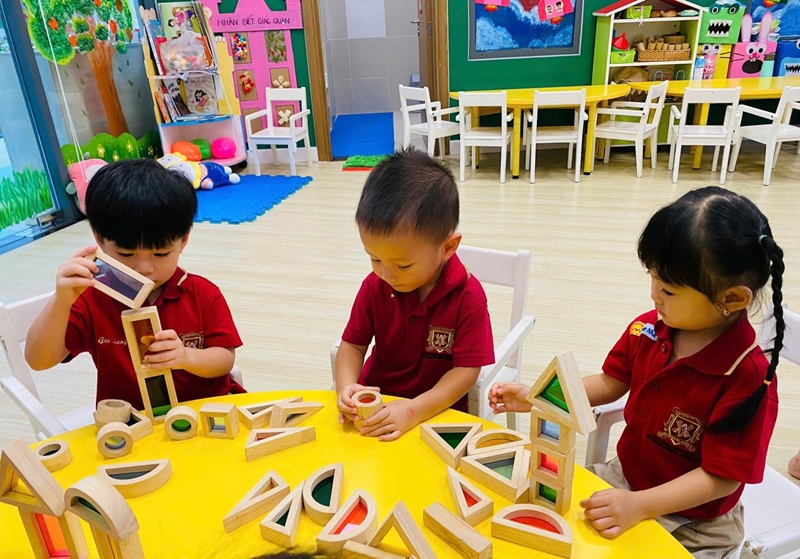
Children develop imagination and geometric awareness through games
3.7. Math games with dice, sticks, number cards and real objects
Learning through play is a suitable method for preschool children. Parents can play dice games with children, use counting sticks, sort colored beads, or use number cards for interactive learning. These activities help children interact with real objects and create more connection during learning.
3.8. Memory and observation exercises
Exercises that require children to compare two similar pictures and find the differences can help improve visual memory and concentration. These are important skills for receiving and processing information later on.
>>> Read more: What Should a 5-Year-Old Learn? 10 Lessons for Holistic Development
4. Effective methods for teaching mathematical thinking to 5-year-olds at home
Teaching mathematical thinking at home does not need to be complicated or too academic like classroom lessons. The important thing is to use age-appropriate methods that combine learning and play, helping children learn naturally without feeling pressured.
4.1. Learning through games and visual activities
Five-year-olds learn best through hands-on experiences. Parents can turn each lesson into a small game, such as a candy-counting contest, toy sorting activity, or shape-building game. These interactive activities can help children remember lessons better and feel more interested in math.
4.2. Using real objects in daily lessons
Instead of relying only on books, parents can use familiar objects such as fruits, cups, pencils, or milk cartons to teach math. For example, parents can place 5 cakes on the table, eat 2 cakes, and ask children how many cakes are left. This method is close to daily life and helps children understand math more easily.
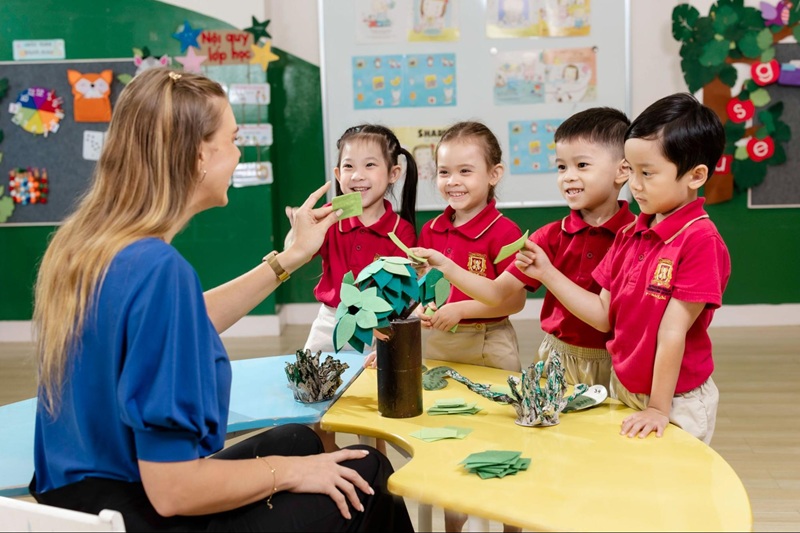
Using familiar objects helps children feel more interested in learning
4.3. Giving step-by-step guidance and asking open-ended questions
Instead of giving children the answer right away, parents should guide them with questions such as:
- “What do you think the next step is?”
- “Why did you choose that answer?”
- “Is there another way to solve it?”
These questions can help children think more independently, develop critical thinking, and avoid depending too much on adults.
4.4. Using selective repetition to reinforce knowledge without boredom
Repetition is necessary for memory, but parents should change the format and context to keep children interested. For example, children can practise addition with number cards today, dice games tomorrow, and a pretend cooking game on another day.
4.5. Creating a positive, pressure-free learning environment
Children learn best when they feel safe, respected, and encouraged. Parents should avoid scolding or comparing children with others when they make mistakes. Instead, parents can recognize children’s efforts, praise them at the right time, and help them overcome challenges in a positive way.
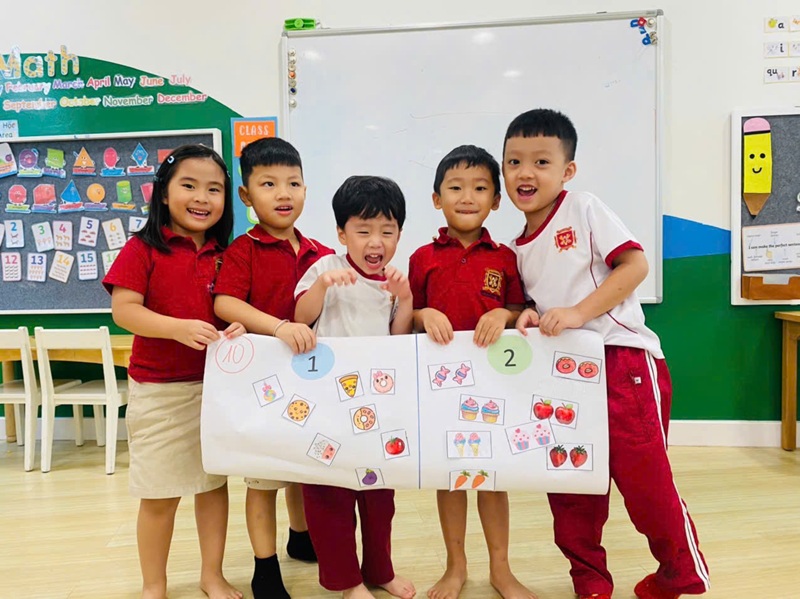
Children can develop more fully in a positive learning environment
4.6. Supporting concentration and thinking through proper nutrition
Nutrition plays an important role in supporting brain development. Foods rich in omega-3, such as salmon and walnuts, along with vitamin B, iron, and zinc, can help support children’s memory and concentration. In addition, enough sleep and regular physical activity also contribute to healthy brain development.
5. Vietnam Australia International School (VAS) – Learning mathematical thinking through a modern preschool programme
Vietnam Australia International School (VAS) is one of the education systems in Vietnam that integrates thinking development into preschool education. With a modern teaching approach, VAS not only helps children recognize numbers and do simple calculations but also encourages independent thinking, creativity, and problem-solving from an early age.
What makes the mathematical thinking programme at VAS stand out?
VAS combines the national preschool programme with the international Cambridge programme. Mathematical thinking is an important part of this approach and is designed around the following principles:
- Child-centered learning: Children learn through exploration, play, and interaction with teachers, friends, and the surrounding environment.
- Practical activities: Instead of learning only on paper, children apply thinking skills through activities such as cooking, building, puzzle games, and practical measurement.
- Development of number sense, spatial thinking, and critical thinking: Children become familiar with patterns, open-ended problems, measuring length with footsteps, and comparing the weight of objects.
- Use of mathematical language: Through word problems, children learn how to express their thoughts, present solutions clearly, and communicate more confidently.
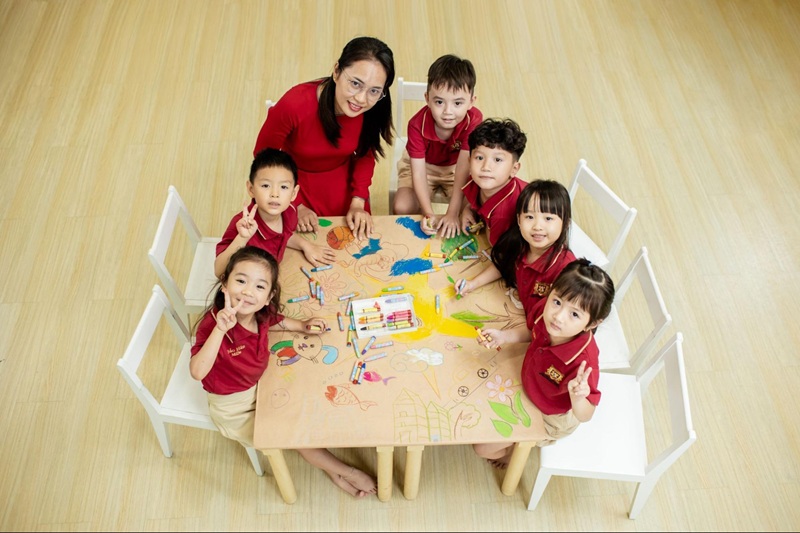
At VAS, children not only learn but also interact and explore through games and practical activities
An inspiring learning environment
VAS classrooms are designed as open learning spaces that encourage exploration and creativity. Children learn in airy classrooms with natural light and visual learning materials. Teachers have professional knowledge and guide children’s thinking through open-ended questions instead of simply giving instructions.
In addition to mathematics, children at VAS are introduced to STEM skills, basic technology, and personal development subjects. This can help children feel more confident when entering primary school and build a stronger thinking foundation for later learning.
>>> Read more: Details of Vietnam Australia International School tuition fees
6. Conclusion
Mathematical thinking is not simply about being “good at calculation.” It is a way to help 5-year-olds develop thinking skills, learning habits, and a positive attitude toward learning. Through mathematical thinking exercises for 5-year-olds, parents can help children develop logical intelligence, creativity, and problem-solving skills from an early age.
For parents looking for a suitable educational environment to nurture children’s thinking skills, Vietnam Australia International School (VAS) is a choice worth considering. With modern teaching methods and an international-standard curriculum, VAS supports children as they explore their intellectual potential in a natural and effective way.
If you are interested in the international education programme at VAS, please contact us via hotline 0911 26 77 55 or visit www.vas.edu.vn for detailed consultation.
>>> Read more: 16 Essential Life Skills to Teach 5-Year-Olds