


Top 11 Effective Ways to Develop Language Skills in Preschool Children
- What is language development for preschool children?
- Language development in preschool children across different age groups
- Is language development important for preschool children?
-
Top 11 ways to develop language skills in preschool children
- 4.1 Teaching children to listen and speak
- 4.2 Reading books with children
- 4.3 Developing language skills in preschool children through art activities
- 4.4 Games that help children build vocabulary
- 4.5 Using music
- 4.6 Teaching children to write and draw
- 4.7 Talk to your child about what is happening
- 4.8 Communicate with children in two or more languages
- 4.9 Let children learn outdoors
- 4.10 Applying learning methods appropriate for children
- 4.11 Become a language role model for young children
Preschool is a golden stage for children’s physical and language development. In many developed countries, language development for preschool children is considered a key priority in education. So, why should parents pay attention to children’s language development, and what methods can help children develop their language skills? Let’s explore the information below with VAS.
1. What is language development for preschool children?
Language development for preschool children means developing children’s ability to listen, speak, read, write, and use language to communicate in daily life.
This is one of the first important skills children need to develop in their early years. Language is the “key” that helps children express ideas, learn new things, and build social relationships later in life.
Depending on each age group, parents can use different methods to support children’s language development in suitable ways.
2. Language development in preschool children across different age groups
Children’s language development varies by age group. Parents can refer to the following stages to better understand how preschool children gradually develop their language abilities:
- 0–12 months old: This is considered the pre-linguistic stage. At this age, children cannot yet pronounce words clearly. They mainly respond to simple sounds and gestures.
- 12–18 months old: Children begin to say basic words and recognize simple words such as “dad” and “mom”.
- 18–24 months old: Children can pronounce more words and start using short sentences to communicate with people around them.
- 2–3 years old: Children can use language to play, communicate, and tell stories.
- 3–5 years old: This is the strongest stage of language development. At this age, children have a larger vocabulary and can speak in longer, more complex sentences. They can even describe a specific story or object in detail.
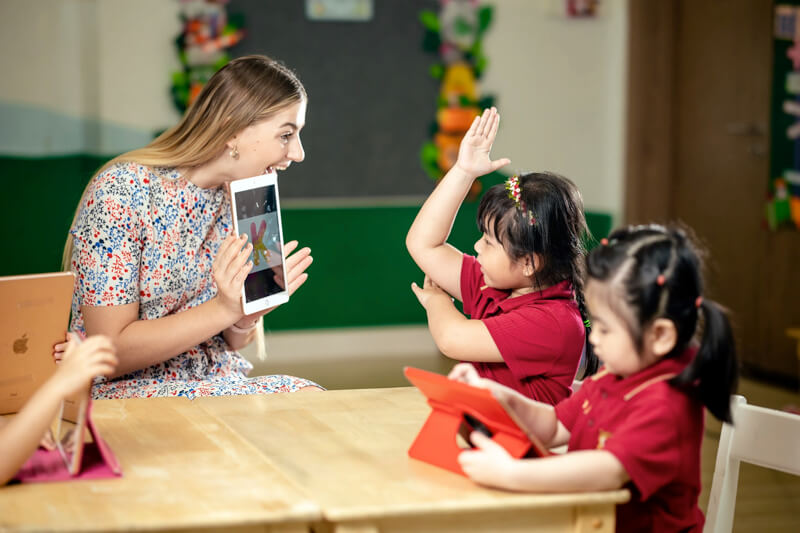
VAS teachers help children develop vocabulary through images
3. Is language development important for preschool children?
Yes. Language development is very important for preschool children because it brings many benefits, including:
3.1. Children develop language skills from an early age
Language is an important tool that helps children express themselves, share their ideas, exchange information, and communicate with friends and teachers while learning and playing.
Focusing on language development from an early age gives children more opportunities to practise listening, speaking, pronunciation, and especially build a richer vocabulary. As a result, their language skills can gradually become more complete.
Early language development also helps improve children’s communication skills and their ability to use language in different situations, bringing many benefits to their future development.
At the same time, language development helps children build vocabulary and grammar skills. Children learn how to use language to communicate, express opinions, and interact with others more effectively. This creates a strong foundation for their learning and communication skills when they enter primary school.
In addition, early language development can support logical and creative thinking. Children become more confident in expressing their ideas and gradually develop their critical thinking skills.
3.2. Stimulating brain development in children
From the ages of 2 to 3, children often ask many questions as they explore the world around them. These constant questions show that their brains are actively working to turn thoughts into language so they can express them as questions.
For this reason, if children are introduced to a new language during this stage, they can often absorb it quickly. This also helps stimulate brain development.
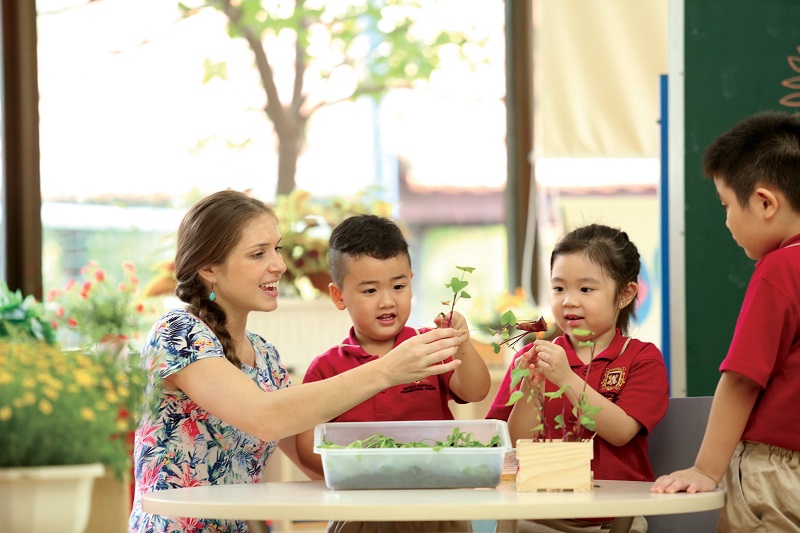
Language helps preschool children broaden their understanding of the world
In general, supporting language development is also a way for parents to bring the world closer to their children. When children’s communication skills improve, they become more aware of the people, objects, and events around them, while also developing stronger thinking skills.
A better understanding of the world can also help children build a clearer sense of direction as they grow, contributing meaningfully to their development later in life.
3.3. Forming and nurturing moral values in children
Language is not only a means of communication. It also plays an important role in forming and nurturing moral values in young children.
From the time children begin to babble, they are taught how to use polite expressions, greet adults respectfully, and say simple phrases such as “hello,” “thank you,” and “sorry.” These small language habits help children build a moral foundation and develop basic standards of polite behavior.
When children are raised and educated in a positive moral environment, they are more likely to become well-rounded individuals, laying the foundation for future success.
3.4. Developing artistic talent in young children
Language development not only supports children’s communication and learning abilities but also creates favorable conditions for them to develop artistic talents. Language helps children express emotions and ideas, as well as explore and create in their own way.
This is often shown clearly through art activities. For example, children can create drawings that reflect the beauty of nature, animals, or playtime experiences. They can also create stories, plays, or poems based on the words and knowledge they have learned.
In addition, children who develop language skills early may have a better ability to appreciate art than children with delayed language development.
4. Top 11 ways to develop language skills in preschool children
4.1. Teaching children to listen and speak
Listening and speaking are essential activities in children’s language development.
Preschool children often imitate what they hear and see. Based on this natural ability, parents can play cartoons, music programs, or educational programs to help children practise simple words and learn how to express their thoughts and needs.
While guiding children to listen and speak, parents should ask prompting questions, moving from basic to more complex levels. This helps stimulate children’s thinking and encourages them to use language to express their ideas.
4.2. Reading books with children
Reading books to children is one of the simplest and most effective methods parents can use, whether during free time or before bedtime.
By listening carefully to stories, children can learn many new words and develop their thinking skills as they understand the story. Through story content, they also learn how to use words appropriately in different contexts.
This helps children’s language ability develop at a higher level. Parents can also encourage children to remember and retell the story, helping them practise memory and information comprehension skills.
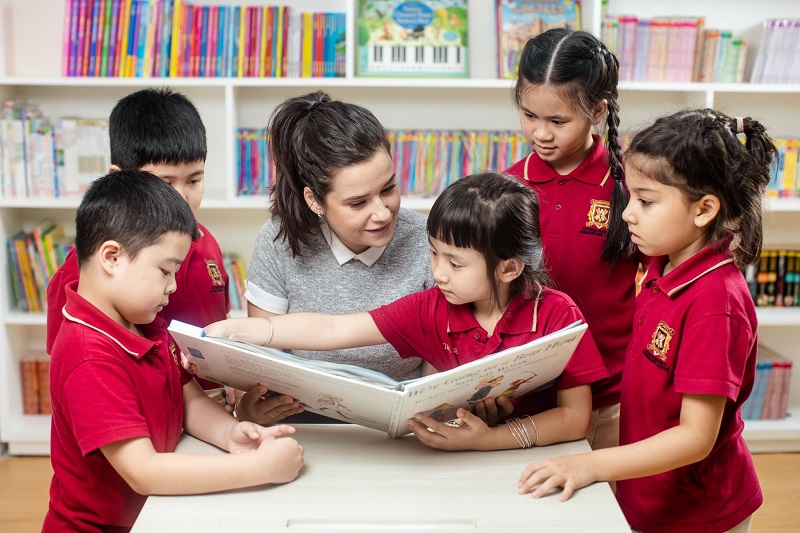
VAS encourages preschool children to build a daily reading habit
Currently, some international schools in Ho Chi Minh City, including VAS, have invested in modern libraries with a wide range of books for students from preschool to high school.
Library equipment is imported directly from the UK to encourage children to build reading habits from an early age. Books at VAS are updated regularly, allowing students to freely explore different fields.
In particular, VAS regularly organizes extracurricular activities such as bookstore visits, reading festivals, and storytelling competitions. These activities encourage children to participate, maintain a daily reading habit, and build knowledge for the future.
4.3. Developing language skills in preschool children through art activities
Letting children regularly take part in art activities not only helps parents discover their natural talents early but also offers an enjoyable way to support language development.
Parents can start with children’s songs or short poems with fun, catchy rhymes to help children learn new words. Activities such as drawing, painting figurines, and coloring letters can also help children recognize colors, practise spelling, and combine basic words.
Joining children’s drama clubs can give children a healthy and lively environment to develop language skills, along with many other important skills.
At VAS, the school regularly organizes exciting extracurricular activities and creative playgrounds to encourage children’s participation, such as:
- Themed drawing activities
- Preschool Ring the Golden Bell
- VAS’s Got Talent
- English public speaking
VAS Young Talent Search Contest 2023
These activities not only help children develop their personal value but also allow the school to discover and nurture young talents in a timely way, helping them grow and contribute to society in the future.
>>> Read more: What do VAS international school tuition fees include?
4.4. Games that help children build vocabulary
Interactive games with family members and friends can help children develop better language and communication skills. Role-playing games, where children pretend to be objects or characters from fairy tales, cartoons, or movies, are especially engaging for preschool children.
Parents can encourage children to create dialogues for their characters and join the game with them. This helps children feel more excited and develop their thinking skills better than when they play alone.
Through games, parents can observe children’s daily growth and clear language development. Playing with children is also a way for parents to help them practise appropriate behavior, learn new vocabulary, and correct unsuitable habits in daily life. This contributes to building good character and basic moral values.
Besides role-playing and acting, parents can also use flashcards, word-matching games, missing-word games in songs, and similar activities to help preschool children expand their vocabulary.
Parents should also use a wide range of words while playing with their children so they can build a richer vocabulary.
For example, when describing actions involving the legs, parents can use different verbs such as “walk,” “stand,” “run,” “jump,” and “hop.” This helps children understand how each word matches a specific action. Parents can also describe or explain the words further so children understand their meanings and usage more deeply.
4.5. Using music
Music combines language and sound. Preschool children often learn quickly through listening because their hearing is highly sensitive at this age.
If a child grows up in a family with a strong musical background, they may naturally develop a more flexible and expressive use of language. However, even if the family does not have a musical tradition, parents can still play cheerful melodies and sing along with their children to stimulate both language and musical development.
Activities such as dancing and clapping to the beat can also help children remember song lyrics better and interact more actively with family members.
International preschools today place strong emphasis on children’s holistic development. As a result, many schools invest in functional learning spaces such as ICT rooms, dance rooms, gyms, and sports areas.
Music rooms, in particular, are equipped with modern, high-quality imported pianos, giving children more opportunities to develop musical appreciation and feel more excited about going to school every day.
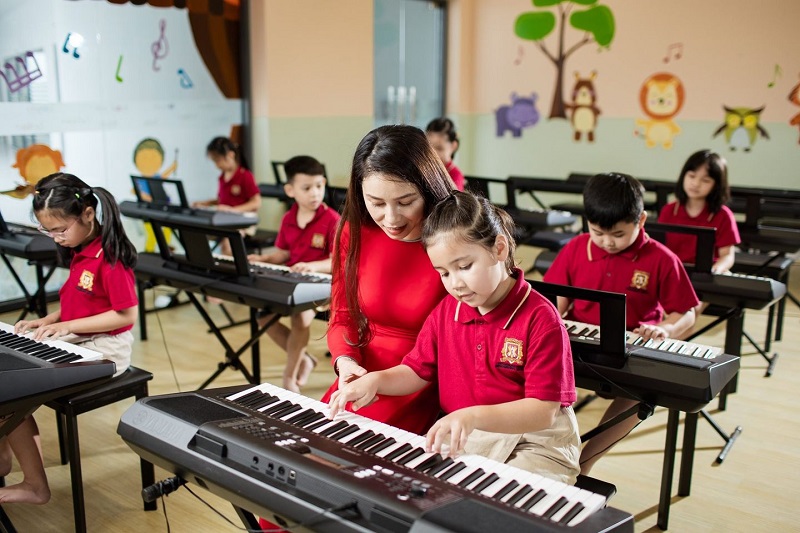
A music class at Vietnam Australia International School - VAS
4.6. Teaching children to write and draw
When drawing, children need to express the ideas in their minds through images. This encourages them to explore and use words and phrases to explain their ideas to others. As a result, preschool children can practise communication skills and expand their vocabulary.
For example, choosing words to describe colors, shapes, and sizes helps children improve their descriptive skills and use language more accurately.
After children complete their artwork, parents can encourage them to create a simple story based on the picture. This stimulates children’s thinking, language use, and creativity. At the same time, parents can gently correct words or expressions that children use incorrectly and explain why, helping children remember vocabulary more deeply.
4.7. Talk to your child about what is happening
Parents can talk to children about simple daily activities, such as:
- “Mommy is giving Bơ a bath and washing Bơ’s hair.”
- “Daddy is playing catch with Bơ. Can Bơ catch the ball?”
- “Bơ is having breakfast. Let’s drink some milk.”
- “Mommy is working now, and Bơ is playing with the little animals.”
Parents often think that if children cannot speak yet, talking to them is meaningless. However, parents should talk to children about even the simplest daily activities from birth, or even during pregnancy.
Children can understand what parents say even if they cannot respond in full conversations yet. This is because children’s language development does not happen evenly between the ability to understand signals and the ability to express ideas.
When parents talk to children, they provide them with more “language symbols”, including meaning and tone. This encourages children to respond through facial expressions and separate sounds, gradually leading to clearer and more accurate speech.
4.8. Communicate with children in two or more languages
During the golden preschool stage, parents can help children develop an additional language besides Vietnamese in many ways. In addition to enrolling children in bilingual preschools, parents can also communicate with them in a second language at home to help build natural language responses.
When changing clothes, bathing children, or playing with them, parents can use simple words and repeat them many times so children gradually become familiar with the new language.
In addition, taking children to supermarkets, playgrounds, or large city centers where they may meet or hear foreigners can also help them become more exposed to and adaptable to a new language.
4.9. Let children learn outdoors
The learning environment plays an important role in children’s language development. Besides learning spaces at home and school, parents should take their children to open, fresh, and nature-friendly places such as zoos, parks, or scenic attractions.
These experiences allow children to take part in free activities, observe the world around them, and develop their ability to receive information through different senses, including hearing, seeing, and touching.
At this stage, parents and teachers should act as companions. They can introduce new vocabulary and answer children’s questions about the world around them, helping children expand both their vocabulary and general knowledge.
4.10. Applying learning methods appropriate for children
Besides the learning environment, choosing an educational method suitable for preschool children is also an important factor for parents to consider when selecting a preschool.
School is like a second home, where children spend more than 50% of their time compared with the time they spend at home.
Therefore, parents should carefully learn about the educational methods used by the school and consider whether they are suitable for their child.
Currently, the Montessori method is widely applied in many schools. It places strong emphasis on children’s language development through specific activities such as:
- Helping children recognize vowels, consonants, and blended sounds.
- Reading and understanding short words and sentences.
- Writing by following models or creating their own writing.
- Practising proper reading habits.
- Forming words or sentences with the alphabet.
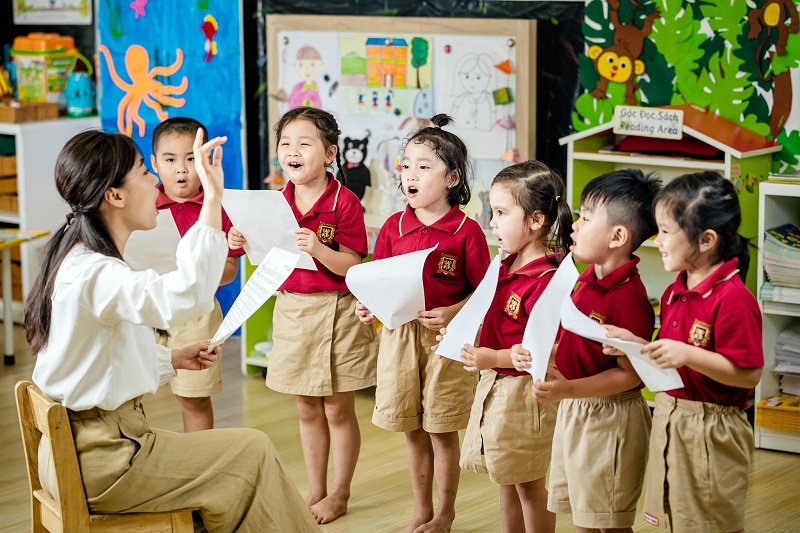
The EYFS “play to learn, learn through play” program helps children develop holistically
In addition to the method above, VAS also applies the EYFS program in its preschool system. EYFS, or the Early Years Foundation Stage from the UK, helps children build 4 essential skill groups before transitioning to the Cambridge Primary Programme:
- Language skills: Children learn to listen, speak, read, and write in both English and Vietnamese through fun activities, without pressure or rigid constraints.
- Thinking development: Children are introduced to Math, Science, and Information and Communication Technology (ICT) through hands-on science-based games.
- Physical development and talents: Children take part in various physical activities, while talent competitions are also regularly organized at school.
- Life skills: Children learn communication, self-care, self-defense, and many other important life skills.
4.11. Become a language role model for young children
Children often learn language by observing and imitating the adults around them. Therefore, parents and teachers should become good language role models for children.
Whenever children are present, adults should use language that is suitable for their age. It is best to use simple, clear, and easy-to-understand words, while avoiding complex terms that children may not yet understand.
Parents should especially avoid swearing or using inappropriate language, as this can form bad habits in children. Instead, parents should use positive words, compliments, and encouragement to help children become more confident.
These are the top 11 methods to support language development in preschool children. If parents would like to learn more about the preschool education program at VAS, please visit www.vas.edu.vn or contact the hotline at 0911 26 77 55.
>>>> Read more:
What Parents Should Prepare Before Their Child Starts Preschool
Common Mistakes Parents Should Avoid When Choosing a Preschool