


What Is an Integrated English Program? Should Grade 1 Children Study an Integrated Program?
In recent years, integrated learning models have gradually become more popular in Vietnam. Today, primary students can also access this program, instead of only older students as in the past. So, what is an integrated program, and should parents enroll their Grade 1 children in one? Let’s explore the information below with VAS.
1. What is an integrated program?
An integrated program, also known as an integrated English program, was introduced in Vietnam in 2014. It combines international education curricula with the Vietnamese education curriculum in a balanced way. By integrating international learning content, the program helps add new knowledge to the foundational subjects already included in the Vietnamese curriculum.
Currently, most integrated programs are taught at international bilingual schools. Many of these programs combine a British curriculum with the standard general education curriculum of Vietnam’s Ministry of Education and Training. The three most common subjects in integrated programs are Math, Science, and English. These subjects are designed to reduce academic pressure, strengthen students’ thinking skills, and support the development of their personal qualities.
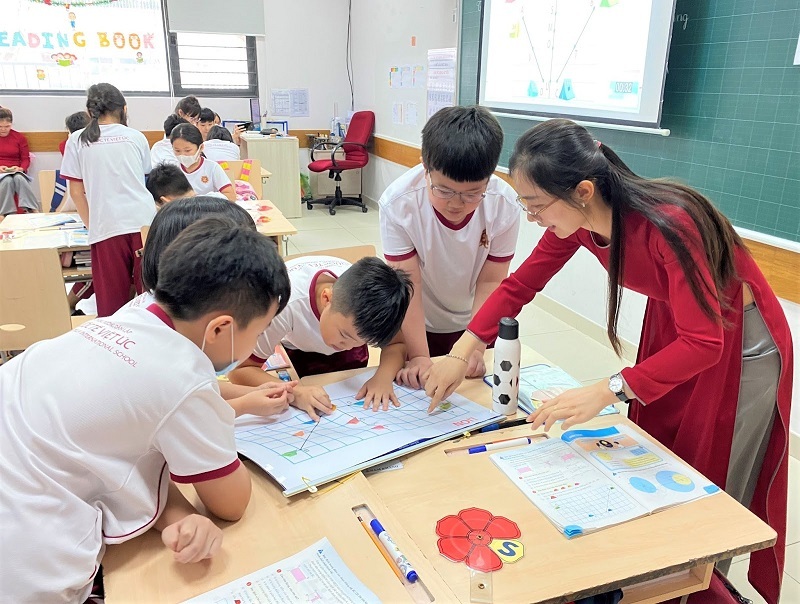
The Grade 1 integrated program helps reduce pressure and create a more comfortable learning experience for students
In this program, students study all subjects required by the standard curriculum of the Ministry of Education and Training, taught by Vietnamese teachers. At the same time, they take an additional 8 periods per week at primary and lower secondary levels, or 15 periods per week at upper secondary level, in English, Math, and Science with native-speaking teachers.
This bilingual model, with Vietnamese and international teachers teaching in rotation, is designed to avoid overlap while allowing the two curricula to complement each other.
As a result, the integrated program helps students build confidence in using a foreign language, explore new knowledge, and continue developing themselves in an increasingly globalized world.
2. What are the characteristics of the integrated program for Grade 1?
Besides the common features of integrated programs, such as:
- Students are introduced to new teaching methods.
- Lesson plans are more diverse, supporting both teaching and learning.
- Students learn in both English and Vietnamese.
- The program reduces academic overload and increases practice time, giving students more hands-on learning opportunities.
- Students are taught by both Vietnamese and international teachers.
The Grade 1 integrated program also has several other characteristics, including:
2.1. Diverse types of integration
Multidisciplinary Integration: A single topic is explored across different subjects. Learning content may be organized into a series of theories or hypothetical situations, requiring students to combine knowledge and skills from multiple subjects. Example: A teacher may use the story Visiting Uncle Ho’s Mausoleum to connect lessons in History and Geography.
Interdisciplinary Integration/ Approach: Students explore related subjects together to research, practice, and learn how to solve problems. Example: For a drawing activity on the topic of traffic safety, children need to apply knowledge from Civic Education and Fine Arts. This helps them arrange the composition of their drawing and illustrate pedestrians and different types of vehicles appropriately.
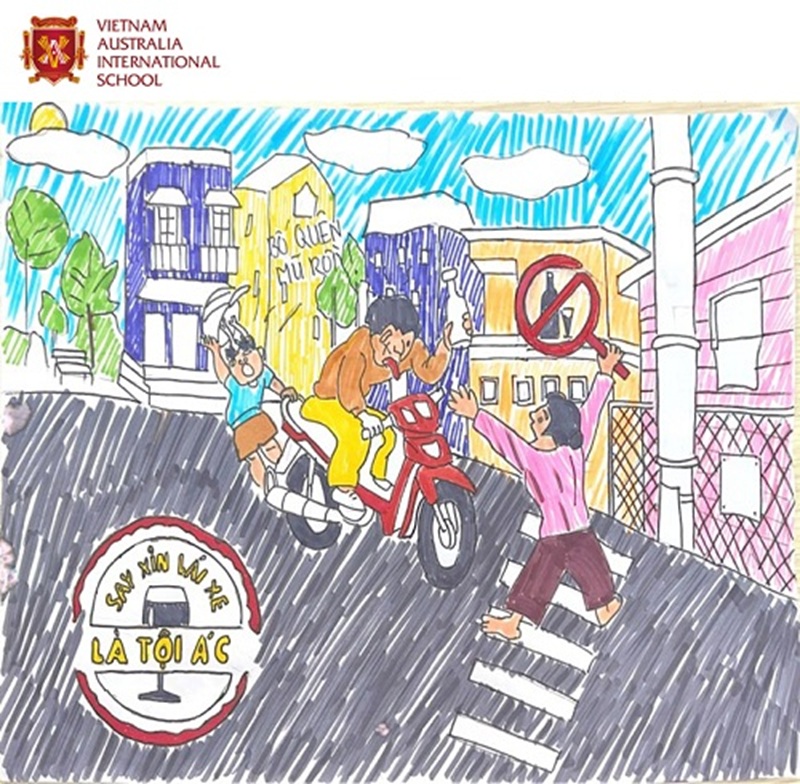
VAS students draw pictures about traffic safety
Intradisciplinary Integration: Two or more topics within a single subject are combined into a practical, real-life theme. Example: In Vietnamese language classes, students learn spelling, sentence and word practice, reading, writing, storytelling, and more. Teachers may ask students to write a paragraph, an essay, or retell a story based on a given topic.
Transdisciplinary Integration: This approach focuses on developing practical skills across subjects that share common characteristics and can be applied in real life. It goes beyond the scope of a single subject, as students need to apply knowledge and skills comprehensively to understand and solve a problem. Example: An environmental protection project may require knowledge of Natural Science to choose a suitable topic, as well as Geography to explain environmental issues and propose appropriate solutions.
2.2. Common subjects in the integrated curriculum
Common subjects in the integrated curriculum include:
- Life Around Us: Integrates Nature and Society for Grades 1, 2, and 3 under the current curriculum.
- Society and Nature Studies: Integrates Science, History, and Geography for Grades 4 and 5 under the current curriculum.
- Language Arts / Literature: Integrates Literature from Grades 1 to 12 and Vietnamese from Grades 1 to 5. This subject covers different areas such as Culture, Civics, Ethics, History, Geography, and Aesthetics. It helps students develop literary appreciation while broadening their understanding of social sciences.
- Civic Education / Ethics: Integrated from the Ethics subject in the current curriculum.
- History and Geography: Integrated into one knowledge area to help students understand the relationship between historical time and geographical space, thereby building foundational social science skills.
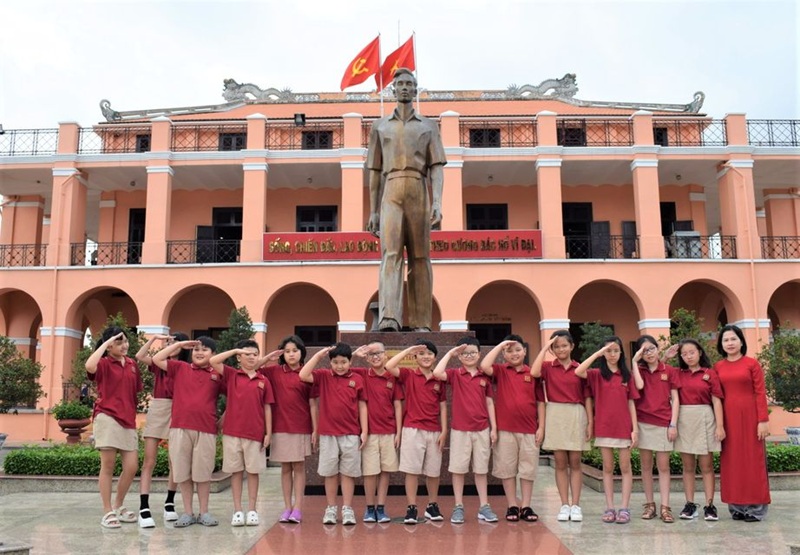
The integrated program combines History and Geography into an engaging subject for students
2.3. Entry requirements for the integrated program by school level
Entry requirements for the integrated program vary by school level.
For primary school: Students do not need to take an entrance exam.
For lower secondary school: Students are required to pass an entrance test. In addition, they need to have completed the primary-level integrated English program or meet one of the following English proficiency requirements:
- Pearson English: Students are required to have a PTE Quickmarch certificate, with a minimum result of 3 out of 5 stars.
- Cambridge English: Students are required to have a Flyers certificate, with a minimum result of 12 out of 15 shields.
- ETS: Students are required to have a TOEFL Primary Step 2 certificate, with a minimum result of 3 out of 4 badges.

Students need to meet certain entry requirements to pursue the integrated program
For upper secondary school:
Students need to pass an entrance test that evaluates their English proficiency and foundational knowledge of subjects taught in English. This helps ensure that they can keep up with the teaching and learning pace of the program.
In addition, students need to have completed the integrated English program at lower secondary level and meet other requirements, such as:
- Students register for two preferences in the integrated English program and are considered for admission based on their Grade 10 entrance exam results and their average score in the lower secondary integrated English program.
- If students did not study this program at lower secondary level, they must graduate from lower secondary school with a “Good” academic ranking or higher, take the Grade 10 entrance exam, take the Integrated English exam, and register for two preferences in the integrated English program.
- Admission is based on the total score of four subjects: Math, Foreign Language, Literature, and Integrated English.
Students who wish to join the program midway through a school level, such as at the beginning of Grade 4 or Grade 8, need to take an entrance assessment conducted by the program provider.
3. Benefits of early exposure to integrated programs for children
Early exposure to integrated programs can bring several benefits for children, including:
- Helping children develop an early interest in Math and Science.
- Supporting the early development of English skills and English-language knowledge, thanks to a learning pathway that connects across school levels.
- Helping students build a wide range of skills throughout the learning process, including presentation, critical thinking, debate, negotiation, questioning, research, and discussion. Through these activities, students work together to build lesson content and find effective solutions under the guidance and support of subject teachers.
- Giving students access to an advanced education model, creating a strong foundation for them to continue their studies at higher levels, including at international universities in Vietnam and abroad.
- Providing recognized qualifications upon completion of the program, including a diploma from Vietnam’s Ministry of Education and Training and internationally recognized qualifications such as certificates from the UK examination board Edexcel, part of Pearson, ACT, IELTS, TOEFL, TOEIC, and others.
4. Does Vietnam Australia International School (VAS) offer an integrated curriculum?
Vietnam Australia International School (VAS) provides education from kindergarten to Grade 12, with 3 integrated learning pathways across school levels based on Cambridge international standards, including:
- CEP – National Programme combined with Cambridge English Programme.
- CAP – National Programme combined with Cambridge General Education Programme.
- CAPI – Fully Integrated Cambridge International Programme.
In particular, VAS is one of the top 4 schools in Ho Chi Minh City licensed by the Ministry of Education and Training to teach the Fully Integrated Cambridge International Programme.
Therefore, parents can feel assured about flexible graduation qualifications, such as Cambridge, IELTS, TOEIC, PET, FCE, TOEFL, A/AS Level, and others. These pathways meet different educational goals of families and students, while also helping students transition more smoothly between school levels and learning pathways.

VAS offers one of the most extensive English learning programs for students
They also help ensure continuity in learning quality and curriculum structure. In the integrated program from Grades 1 to 5, students study English, Math, and Science, along with several arts, enrichment, and supplementary subjects, for 10 to 18 periods per week.
In the CAP program for Grades 1 to 9, English learning time increases to 22 to 25 periods per week, with 4 to 6 core subjects taught in English, including:
- English
- Math
- Science
- ICT or Computer Science
- Economics or Business
- Global Perspectives
At the end of each program, students take the Primary and Lower Secondary Checkpoint exams.
VAS can be considered a pioneering international school with extensive English learning time among bilingual schools. In addition, students learn directly with native-speaking teachers from countries such as the UK, the US, Australia, and Canada. This gives students the opportunity to experience English in a more natural and comprehensive way, while developing their interest in the language and improving their pronunciation and intonation.
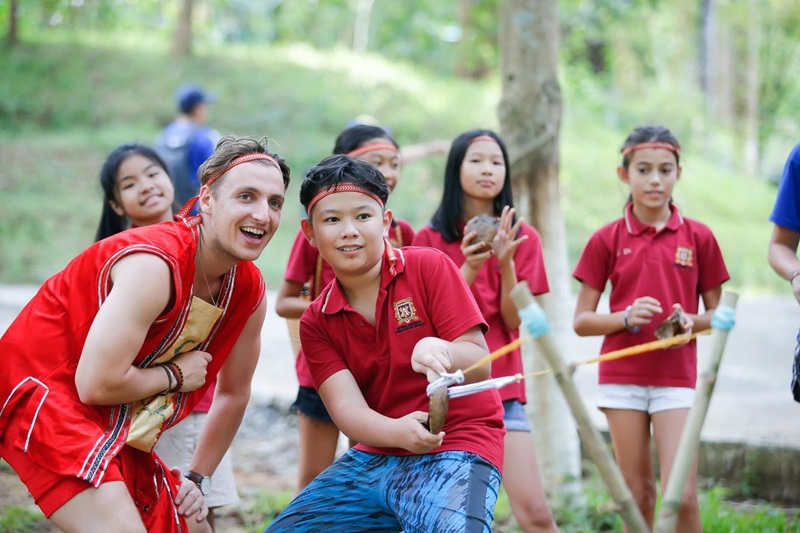
VAS offers a wide range of extracurricular activities for students
In addition to its integrated academic programs, VAS also offers a wide variety of extracurricular activities, practical field trips, life skills education programs, sports and arts activities, and community projects. These activities help children develop physically, creatively, socially, and academically.
The information above gives parents and students a comprehensive overview of the Grade 1 integrated program. It also helps parents answer the important question: “Should I enroll my child in an integrated program?”
>>> Read more: Details of Vietnam Australia International School tuition fees
To learn more about Cambridge-standard international learning pathways, attractive enrollment offers, or to visit the learning environment at Vietnam Australia International School (VAS), parents can register at www.vas.edu.vn or contact 0911 26 77 55.
>>> Read more: Top 20 international primary schools in Ho Chi Minh City